Category: Targeted Individuals

  • Fusion Centers Under Scrutiny: Karen Stewart’s Claims

    In the interview excerpts, Karen Stewart challenges whether fusion centers are fulfilling their stated counterterrorism purpose. She describes a system intended to connect national intelligence with local authorities after 9/11, but alleges that it has become a vehicle for targeting innocent Americans. Her central accusation is that the fight against terrorism provides cover for harassment, reputational destruction, and retaliation against people who have never been charged with a crime.

    Stewart alleges that ordinary Americans are fraudulently placed on what she calls “tier 3 and tier 4” terrorist lists and designated “non investigative subjects.” She claims operatives then approach their neighbors with false allegations of terrorism or sexual misconduct, encouraging community members to participate in harassment. If substantiated, such conduct would raise serious questions about civil liberties and accountability. However, the excerpts provide no watchlist records, operational documents, or independently corroborated testimony establishing this alleged process.

    Her allegations extend to the recruitment of neighbors, churches, community organizations, and criminal gangs, sometimes through gift-card payments. Stewart describes coordinated vehicle following, property damage, and harassment that allegedly continues when someone moves across state lines. She also attributes physical symptoms to electromagnetic weapons and alleges that her own treatment followed an employment dispute involving the NSA. These are serious accusations, but her account alone does not establish who caused the incidents she describes, whether they were coordinated, or what caused her symptoms.

    Stewart further claims that fusion centers have failed to identify terrorists or stop terrorist plots while receiving billions of dollars, and that officials evade congressional scrutiny by invoking security clearances. Those sweeping assertions require evidence beyond the interview: the excerpts contain no comprehensive performance review, funding analysis, or congressional record supporting them. A balanced assessment would also examine the centers’ responses, documented activities, and the distinction between producing intelligence and directly making arrests.

    The interview ultimately presents a demand for scrutiny, rather than proof of a nationwide harassment operation. Stewart’s allegations warrant careful evaluation against records and independently verifiable evidence, with an opportunity for the institutions accused to respond. Counterterrorism responsibilities should carry meaningful oversight and protections against abuse, while conclusions about specific wrongdoing must rest on more than the seriousness of an accusation.

  • Could A Secret Surveillance Opinion Expose The Targeted Individual Program?

    A still-secret surveillance court opinion is raising serious questions about government intrusion into Americans’ private communications. In an October 26 letter, Senators Ron Wyden and Adam Schiff demanded the release of a March 17, 2026, Foreign Intelligence Surveillance Court opinion that they say documents “serious abuses of Americans’ rights” under FISA Section 702. According to the senators, the administration missed the September 13 deadline for releasing a declassified version. The distinction matters: the public currently has the senators’ description of the opinion, rather than its detailed findings. wyden.senate.gov

    Section 702 is designed to collect foreign intelligence by targeting non-U.S. persons reasonably believed to be outside the United States, without obtaining individual warrants for each foreign target. However, Americans’ communications can also enter these collections when they communicate with those targets. Subsequent searches involving Americans’ identifiers raise a separate privacy concern: how far can the government examine someone’s communications without individualized judicial approval? Intelligence agencies argue that these searches help identify threats, while the program’s restrictions prohibit deliberately using a foreign target as a pretext to surveil an American. intelligence.gov

    For people who describe themselves as targeted individuals and report intrusive surveillance, publication could provide a clearer basis for evaluating specific allegations. If the opinion identifies improper searches, inadequate safeguards, or failures of oversight, those findings could help journalists, civil liberties organizations, and attorneys ask more precise questions about government practices. But documented abuses within a surveillance program would not, by themselves, establish that any particular person was monitored or substantiate broader claims of coordinated harassment. Individual allegations still require evidence connecting the person’s experience to identifiable conduct.

    The opinion’s potential value therefore lies in what disclosure might make possible: informed scrutiny, stronger safeguards, and accountability for demonstrated violations. Wyden and Schiff identify proposed reforms including warrants for searches of Americans’ communications, restrictions on government purchases of Americans’ information from data brokers, and limits on entities compelled to assist surveillance. Their letter also notes a significant complication: the same March opinion that reportedly detailed abuses allowed surveillance to continue for another year. It should therefore not be portrayed as a blanket ruling outlawing Section 702 or automatically granting relief to people alleging surveillance. wyden.senate.gov

    A balanced response should take both national security needs and privacy violations seriously. People reporting surveillance deserve a fair assessment of their evidence, and government agencies deserve scrutiny when credible findings indicate they exceeded their authority. Releasing the opinion would help the public distinguish lawful intelligence gathering from documented misconduct—and documented misconduct from allegations that remain unverified. For targeted individuals seeking recognition of a specific privacy violation, that transparency could be useful, even though it cannot substitute for evidence in an individual case.

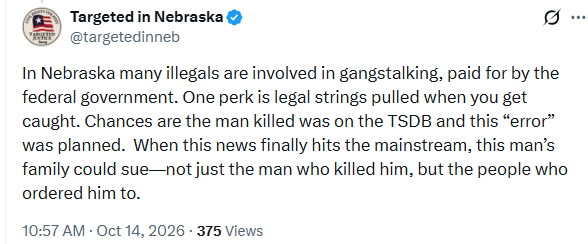
  • Gangstalking, Undocumented Immigrants, and the Intelligence Community: The Question of Plausible Deniability

    Among individuals who identify as targeted individuals (TIs), a persistent and controversial belief is that intelligence agencies and their intermediaries recruit undocumented immigrants to participate in organized surveillance, stalking, intimidation, and psychological harassment. According to this theory, individuals whose immigration status makes them vulnerable to exploitation may be particularly attractive to clandestine operations because their identities, employment histories, and movements can sometimes be difficult to verify. Some targeted individuals allege that participants operate under assumed names, provide false biographical information, or conceal their actual places of birth, creating additional obstacles for anyone attempting to establish their identities. These allegations remain unsubstantiated as a widespread intelligence practice, but they raise broader questions about accountability, exploitation, and the potential abuse of vulnerable populations.

    Another recurring allegation concerns how these purported participants are compensated. Targeted individuals frequently describe arrangements involving prepaid gift cards, cash payments, transportation, housing assistance, and other benefits that allegedly leave little conventional financial documentation. The theory is that such compensation could obscure the identity of whoever finances an operation, particularly if intermediaries are used to distribute payments. However, gift cards and cash are not necessarily untraceable; investigators can sometimes reconstruct transactions through purchase records, surveillance footage, electronic communications, and other evidence. Nor is there verified evidence establishing that American intelligence agencies systematically compensate undocumented immigrants to harass civilians. Nevertheless, the broader concern about covert financing deserves consideration because financial opacity can complicate efforts to identify who authorized, funded, or benefited from unlawful activities.

    At the center of these suspicions is a concept familiar to intelligence professionals: plausible deniability. Intelligence organizations have historically employed intermediaries, informants, contractors, and proxy networks to conduct sensitive operations while limiting direct institutional exposure. That documented history helps explain why some targeted individuals suspect similar arrangements could be used against ordinary Americans. In their view, recruiting people with uncertain or difficult-to-verify identities, compensating them indirectly, and maintaining several layers of separation between participants and government officials would create an especially effective shield against accountability. Yet the existence of covert methods in legitimate intelligence operations does not establish that the specific gangstalking arrangements alleged by targeted individuals are occurring. Distinguishing historical precedent from contemporary allegations is essential to any credible investigation.

    The controversy also raises an important ethical question about undocumented immigrants themselves. Individuals lacking secure immigration status can be vulnerable to coercion, financial exploitation, and threats involving deportation. If government personnel or private intermediaries were ever found to have exploited those vulnerabilities to recruit participants for unlawful surveillance or harassment, the consequences would be serious for both the alleged victims and the individuals pressured into participating. At the same time, immigration status must never be treated as evidence of criminal conduct. The overwhelming majority of undocumented immigrants should not be implicated by accusations directed at unidentified individuals. Any legitimate investigation would need independently verifiable evidence, including financial records, communications, witness testimony, and documented connections to identifiable officials or organizations.

    Ultimately, the issue deserves neither automatic acceptance nor reflexive dismissal. Allegations that intelligence agencies secretly finance civilian harassment through undocumented intermediaries are serious and require equally serious evidence. If substantiated, such operations could raise profound constitutional questions involving privacy, due process, civil liberties, and government accountability. If unsupported, the allegations risk unfairly stigmatizing immigrant communities and diverting attention from demonstrable wrongdoing. Plausible deniability must never become a substitute for accountability, but neither can the mere possibility of plausible deniability serve as proof of a conspiracy. For targeted individuals seeking answers, the strongest path forward remains transparent investigation, independently corroborated evidence, and meaningful oversight capable of establishing what actually happened, who was responsible, and whether any laws were violated.

  • A UK Legal Challenge Could Offer Lessons for Targeted Individuals in America

    A British advocacy effort involving people who identify as “targeted individuals” is seeking international scrutiny of allegations of organised harassment and electromagnetic abuse. In a circulated announcement, Justice4All says group applications were filed against the United Kingdom at the European Court of Human Rights on August 10, 2026, alleging government failures to disclose and regulate microwave weapons. For people who have struggled to have their complaints heard, the reported filing represents a potential avenue for seeking accountability. Its significance, however, must be measured carefully: submitting applications does not establish that the Court has declared them admissible or found the allegations credible. (echr.coe.int)

    The announcement also highlights a graphic describing a Metropolitan Police response of “neither confirm nor deny” to a freedom of information request concerning microwave devices and through-wall sensors. That language can frustrate people seeking clarity, but it does not establish that the alleged abuse occurred. A separate, documented 2024 Information Commissioner decision upheld the Home Office’s refusal to confirm or deny holding information about such devices on national security grounds. The decision concerned the government’s disclosure obligations; it did not find that individuals had been subjected to electromagnetic attacks or torture. Maintaining that distinction is essential to understanding what these proceedings can—and cannot—demonstrate. (ico.org.uk)

    Behind the dispute lies a legitimate public question: how can governments protect sensitive capabilities while ensuring that allegations of abuse receive meaningful examination? People reporting harassment, pain or unexplained injuries deserve respectful treatment, appropriate medical care and an impartial assessment of their complaints. Determining what caused those experiences requires reliable evidence, including documented incidents, independently assessed medical findings and technically sound measurements where relevant. Secrecy should be subject to lawful oversight, while allegations should be tested through a process capable of distinguishing substantiated misconduct from explanations the evidence does not support.

    For targeted individuals in the United States, the potential value of the British effort would largely be indirect. The United States is not a party to the European Convention on Human Rights, and a judgment against the United Kingdom would not bind American courts or prove an American claimant’s allegations. Nevertheless, credible evidence or substantive findings emerging from the proceedings could inform American advocacy, research and public debate. A carefully documented case could also offer practical lessons about framing complaints, challenging secrecy and identifying the evidence needed for meaningful legal scrutiny. Any influence would depend on what the proceedings actually establish. (app.echr.coe.int, wsj.com)

    The reported applications are therefore worth following with both interest and discipline. Their importance will become clearer through official documentation, admissibility decisions and any eventual findings. For Americans seeking answers, the greatest contribution would be a verifiable record that lawyers, researchers and oversight bodies can evaluate independently. Whatever the outcome, the principle remains compelling: people deserve a fair hearing, serious allegations warrant careful examination, and accountability is strongest when transparency is paired with evidence.

  • Geral Sosbee’s Allegations: What His FBI Background Tells Us

    An X post by Jim’s Coffee, @RealCoffeeJim, draws attention to Geral W. Sosbee’s allegations of stalking, psychological harassment and directed-energy attacks by the FBI and CIA. The handle shown in the screenshot matches the account’s X posts. Sosbee’s claims resemble accounts shared by people who call themselves targeted individuals. Does his professional background lend those allegations credibility—and how far can that credibility reasonably extend?

    Geral W. Sosbee alleges that the FBI and CIA have subjected him and other civilians to stalking, psychological harassment and directed-energy attacks. His claims resemble accounts shared by people who call themselves targeted individuals. The question is whether his professional background lends those allegations credibility—and how far that credibility can reasonably extend.

    Sosbee’s FBI service is real. A federal appeals court opinion identifies him as an FBI special agent who participated in a 1972 arrest, and the State Bar of Texas confirms that he later became a licensed attorney. Those records substantiate significant parts of his résumé. I found no independent record establishing that he worked for the CIA, however, and the court opinion alone does not confirm the exact 1971–1978 service dates stated in the circulating post. app.midpage.ai

    Sosbee has set out his allegations in a sworn affidavit, describing what he believes are electronic attacks and a broader campaign against him. His former FBI role is a reason to examine that account seriously. But an affidavit records what its author swears to; it does not independently verify the cause of his experiences or prove that the FBI and CIA operate the program he describes. His service in the 1970s also cannot, on its own, establish knowledge of alleged operations decades later. stop007.org

    The similarities to targeted individuals’ accounts are striking: sleep disruption, surveillance, isolation and suspected electronic attacks recur in both. Similar reports warrant careful investigation and humane treatment of those making them, but they do not by themselves identify a common cause or perpetrator. The FBI’s documented history of COINTELPRO gives the public reason to scrutinize allegations of government abuse. It does not establish that Sosbee’s particular allegations are true. www.fbi.gov

    There is room here for both skepticism and accountability. A 2025 U.S. intelligence assessment acknowledged that personnel reporting anomalous health incidents experienced genuine symptoms; it also found no compelling intelligence linking a foreign actor to any specific reported incident. That assessment did not resolve Sosbee’s claims about civilians or domestic agencies. His FBI credentials and the parallels with targeted individuals’ reports make his account worth examining, while independent records, witnesses and technical evidence remain necessary to determine what happened. www.odni.gov

  • Havana Syndrome and the Cars at the Center of Catherine Herridge’s New Report

    Catherine Herridge has reported a striking new allegation in the Havana syndrome investigation: since early August, a senior official at the Office of the Director of National Intelligence and a senior defense official involved in directed energy technology have reported being targeted. According to Herridge, the incidents involved suspicious vehicles that may have contained a directed energy device. That word matters. The report raises the possibility of attacks on U.S. soil, but the material made public so far does not establish that the vehicles carried a device or that an attack occurred.

    The cars are the part of this story that demands the closest scrutiny. A vehicle could allow someone to approach a target, move away quickly and change locations. But a suspicious car near someone who becomes ill is not, by itself, evidence that the car caused the illness. Investigators need to establish where the vehicles were, who occupied them, whether any equipment was detected, and whether medical findings and other records support the reported sequence of events. Those are questions that can be investigated without dismissing the officials’ accounts.

    Herridge’s reporting also refers to a government analysis of a suspected device described as “far advanced.” Even if that analysis is accurate, it does not yet connect the device to these particular vehicles or incidents. The broader intelligence picture has been contested: a publicly released 2025 assessment said most U.S. intelligence agencies continued to judge foreign involvement in anomalous health incidents very unlikely, while two agencies had become more open to the possibility of a foreign capability.  Neither that assessment nor the new allegation should be treated as the final word on the reported car incidents.

    Herridge says she sought comment from the CIA, defense and homeland security officials, and the DNI’s office about the device analysis and suspected domestic attacks. She reported that the CIA acknowledged receiving her questions but that she had received no substantive response. Silence does not confirm the allegations, yet these claims warrant a clear accounting from the agencies that can examine the evidence.

    If the vehicles were used to target officials, the implications for their safety and national security would be grave. If the evidence points elsewhere, the people who reported symptoms still deserve a careful investigation and appropriate care. The public deserves to know what investigators can substantiate about the cars, the suspected device and any connection between them. That is where this potentially explosive story must go next.

  • U.S. Confirms Weapons in Space — and Targeted Individuals Say Their Claims Deserve a Second Look

    For years, people who identify as “targeted individuals” have claimed that sophisticated directed-energy or electromagnetic technologies are being used covertly against people, with some alleging that weapons can operate from satellites or other space-based platforms and specifically pointing to the U.S. Space Force. Those allegations remain unproven, but roundly dismissing targeted individuals as simply “crazy conspiracy theorists” because the technologies they describe sound impossible is no longer a sufficient response. On September 14, Air Force Secretary Troy Meink publicly acknowledged for the first time that the Space Force has deployed “on-orbit space control weapons” capable of defending U.S. forces against hostile action. The following day, Chief of Space Operations Gen. Douglas Schiess was even more explicit: “Guardians operate on-orbit weapons.” Officials, however, have not publicly disclosed precisely what those systems are or how they operate. 

    For targeted individuals, the disclosure will understandably be viewed as vindication of at least one premise they have advanced for years: sophisticated military weapons really can operate in space, while significant details about their capabilities can remain outside public view. But that is very different from vindicating the much more consequential allegation that directed-energy weapons have been secretly used against civilians. Nothing in Meink’s announcement establishes that the newly acknowledged systems are directed-energy weapons, that they are designed to strike people on Earth, or that they have ever been employed against Americans. The Pentagon’s description instead places them in the context of defending the Joint Force from adversary space capabilities. 

    That distinction should cut both ways. Targeted individuals cannot reasonably cite the announcement as proof that their particular injuries or experiences were caused by government weapons; establishing that would require independently verifiable evidence connecting an actual system and operator to an alleged incident. But skeptics should likewise distinguish between questioning the evidence for an allegation and declaring the underlying technology inherently impossible. The government has now acknowledged operational weapons in orbit while withholding important information about their nature. That alone makes rigorous investigation—and demands for specific answers—more appropriate than ridicule.

    There is also a broader question of government transparency. Critics of national-security agencies have long argued that secrecy can produce a familiar pattern: officials decline to acknowledge classified capabilities until disclosure becomes strategically useful, technically unavoidable, or otherwise appropriate. In this case, Space Force leadership itself has explained that the public acknowledgment was deliberate; Schiess said officials believed “it was time” to say publicly that such weapons existed, citing the evolving space threat.  That history of secrecy does not establish that targeted individuals’ allegations are true. But given that some targeted individuals allege extremely serious consequences from supposed directed-energy attacks—including alleged deaths—and have raised claims about nonconsensual experimentation, the appropriate response should be evidence-based scrutiny rather than assuming either guilt or impossibility.

    That is where the Pentagon arguably owes the public considerably more specificity. Have any directed-energy or other advanced weapons under U.S. military control ever been tested or deployed against civilians inside the United States? Have unwitting civilians ever participated, without informed consent, in experiments involving such technologies? If either occurred, under what statutory, constitutional or other legal authority was it conducted, what oversight existed, and what avenues for investigation and compensation would be available to anyone harmed? Those questions incorporate allegations made by targeted individuals without treating those allegations as established facts. The government’s admission that weapons are operating in orbit does not prove their case—but it makes transparency about what these systems can and cannot do, and the rules governing their use, all the more important.

  • Government Expert Says Directed Energy Technology Can Be Weaponized and Used Domestically

    In a recent interview with NewsNation’s Katie Pavlich, Dr. James Giordano discussed the growing capabilities of directed energy technology, arguing that portable systems—including devices that could potentially be carried in backpacks—have advanced to the point where they should be taken seriously as a national security concern. According to the excerpt shared here, he said the technology is “not science fiction,” that it can be weaponized, and that adversaries are developing and employing such capabilities. He also suggested these systems could present risks in public spaces and other everyday environments.

    For years, targeted individuals have claimed they were being attacked with concealed microwave or other directed energy devices, but those accounts have often been dismissed as conspiracy theories or written off as impossible because many people believed no such technology existed. Dr. Giordano’s comments do not confirm those individual claims, but they do underscore that directed energy technology is real, can be weaponized, and is viewed by at least some national security experts as a legitimate concern. That has prompted renewed discussion about whether some claims that were once broadly dismissed deserve to be examined more carefully in light of advances in the technology.

    The conversation may therefore be shifting away from whether directed energy technology exists—it clearly does in military and research settings—to how governments will address the possibility of its misuse. If portable directed energy weapons can be weaponized and concealed, the focus naturally turns to what measures will be put in place to detect them, deter their use, investigate credible reports, and protect the public. As these technologies continue to evolve, transparent public discussion, rigorous scientific investigation, and appropriate security policies will be essential to distinguish demonstrated capabilities from speculation while ensuring society is prepared to respond to any legitimate emerging threats.

  • TIs & Wage Theft

    Some time in April I got a new job with a security company working guess where? At some shelter😳 Is that my destiny?😂

    Anyway, as I had stated earlier, I had to get away from the Amazon job because that was strictly for voucher purposes—can’t survive in NYC on a 21 hour a week job.

    I didn’t officially quit the Amazon job because I didn’t know what to expect with the security job—I actually had very low expectations, if I’m being honest

    So I went into the security job basically as a tourist, just seeing if it’s something I wanted to do and if not, going back to Amazon while looking for something else.

    Turns out however that it’s a pretty decent company, PLUS it’s a union job, so even better. Even though I’m scheduled for 40 hours at this shelter location, there are plenty of opportunities to pick up extra shifts at other locations, or even do a double shift (16 hours) at the shelter😳 Not bad at all.

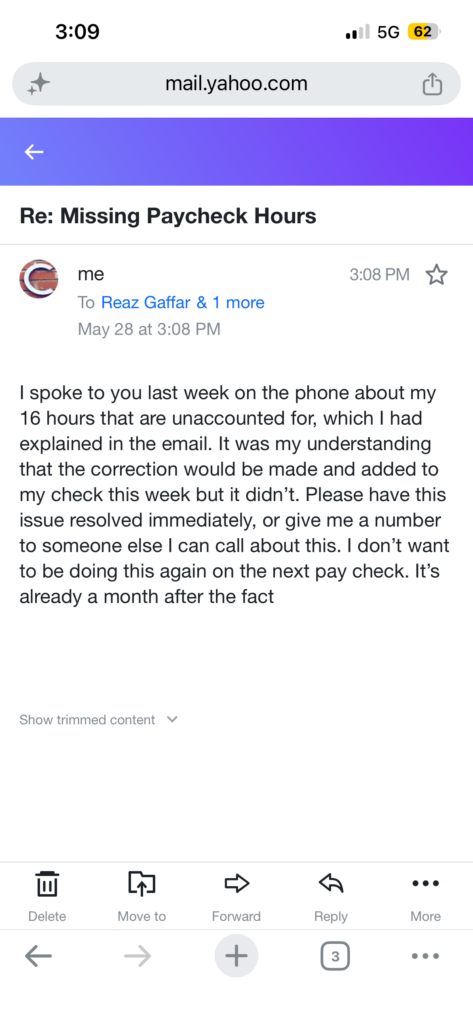
    So I did about three weeks on 40 hours to see if there would be any “issues” with my paycheck—a common problem for targeted individuals😂🤦‍♀️

    The 40 hour work weeks went fine—no issues to report. So on the week beginning…a TI decided to kick up his game a notch, and venture into the overtime territory—just to see how the check would look with 48 hours. So I did 48 hours on the week beginning…and did the same thing for the week after that. So two weeks with 48 hours back to back.

    Next thing I know “problems” with BOTH the checks where I had overtime😂🤦‍♀️You really can’t make this stuff up. Remember I wrote about this VERY SAME issue with the Amazon job when I decided to work more than 21 hours. It’s NOT a mistake—very deliberate

    This however, is what many TIs fail to get—the psyop they fail to realize. It is NOT about the money. They do this so that the TI begins to associate overtime with problems, so the YOU YOU YOU the TI begins to shy away from overtime—Why should I do overtime when I’m not even going to get paid? You get it?🤔 Everything is fine UNTIL the TI starts going for overtime. They want you earning survival money, not thriving money

    Anyway, even though this issue is from the week in the beginning of May, they still haven’t fixed it even as we’re heading into June. A TI’s 16 hours of wages just STOLEN. Sad.

    Most TIs are also broke—living paycheck to paycheck, so issues like this can really disrupt their work, even though they haven’t done anything wrong. Luckily for me, I’m not that broke, so I have the luxury of waiting for my money without getting in anybody’s face. Nobody should be chasing anybody down for their paycheck like this, though—TI or no TI. Matter of fact, isn’t that a crime?😂🤷‍♀️

    Anyway, my plan is to hang around at this shelter location for a little longer then request a move to another site. I don’t want to “rock the boat” too early. I can tell you right now, things are not going to end well here if I have to do this “catch me if you can” routine with my paycheck every time I have some overtime.😂

    I’ll keep you posted on paycheckgate.

    Also wanted to point out that my plan this year, after securing an apartment, was to start writing a book—you read that right—a book about my experiences as a TI. The website doesn’t do TIs a lot of justice because often times it describes incidents that can be dismissed as one-offs, even though they are not. A book with actual chapters and paragraphs will do a better job, imho, laying out how the TI program works. So if you don’t see a lot of posts from me this year, just know that I’m putting them into a book. Only fragrant incidents like this paycheckgate will appear on this website.😂

  • Is This Proof That Regular Civilians Are Also Attacked By DEWs?

    A remarkable and deeply controversial claim is now circulating after a New York Post report highlighted the story of journalist Alisa Valdes-Rodriguez, who says she is leaving the United States after allegedly experiencing what she describes as “directed energy weapons” attacks connected to her reporting on Jeffrey Epstein and his New Mexico network. According to the article, Valdes-Rodriguez believes she suffered symptoms resembling what has often been referred to as “Havana syndrome,” a term tied to mysterious neurological incidents reported by diplomats, intelligence officers, and other government personnel.

    For years, discussions surrounding directed energy weapons and Havana syndrome have largely been confined to the world of intelligence agencies, embassies, military operations, and classified national security conversations. Governments, particularly in the United States, have generally framed the issue as one affecting diplomats, CIA personnel, or other officials operating overseas. The public narrative has consistently suggested that these incidents are rare, specialized, and tied to geopolitical conflict. That framing has frustrated many so-called “targeted individuals,” ordinary civilians who have long argued that similar technologies or tactics can also be used domestically against non-governmental people.

    Valdes-Rodriguez’s claims are now drawing attention precisely because she does not fit the traditional profile that officials have usually associated with these alleged attacks. She is not a diplomat stationed abroad. She is not an intelligence officer operating in a hostile foreign capital. She is a journalist and author who says her work investigating Epstein’s New Mexico connections placed her in dangerous territory. Whether people believe her claims or not, the significance lies in the fact that a mainstream media outlet is reporting on a civilian making allegations that resemble the same kinds of symptoms and experiences previously associated almost exclusively with government personnel.

    That matters because targeted individuals have spent years arguing that the public conversation surrounding directed energy weapons has been artificially narrow. Many of them believe the government has dismissed or ignored civilians who report neurological symptoms, unexplained auditory phenomena, pressure sensations, sleep disruption, cognitive issues, or other unusual experiences. Critics have often labeled such claims as paranoia or conspiracy theories, particularly when they come from ordinary citizens without institutional backing. Yet when diplomats reported similar symptoms, the issue suddenly became a matter of congressional hearings, intelligence reviews, and national security investigations.

    The contradiction has fueled enormous anger within targeted individual communities. Their argument has always been simple: if advanced technologies capable of affecting the human body exist at all, why would civilians automatically be excluded as possible targets? From their perspective, the government’s position has appeared inconsistent. On one hand, officials acknowledge mysterious neurological incidents affecting American personnel overseas. On the other hand, civilians making similar allegations are frequently dismissed outright before any serious inquiry occurs.

    The Valdes-Rodriguez story is therefore being interpreted by some as a potential crack in that wall of skepticism. Again, none of this proves her allegations are true, nor does it independently verify the existence of a domestic directed energy campaign against civilians. But the mere fact that a journalist connected to high-profile Epstein reporting is publicly describing experiences she believes are linked to directed energy attacks gives new visibility to a conversation that has long existed on the fringes.

    The Epstein angle also intensifies public intrigue because his network has remained the subject of endless speculation regarding intelligence ties, elite protection systems, blackmail operations, and institutional failures. Whenever someone connected to investigating Epstein makes alarming claims, those claims inevitably attract attention far beyond the usual audience interested in Havana syndrome debates. That combination — Epstein, intelligence speculation, and alleged directed energy attacks — creates a story that many people will view through the lens of secrecy and distrust toward powerful institutions.

    Skeptics will naturally argue there is still no publicly verified evidence proving that civilians are being targeted with directed energy weapons inside the United States. They will point to psychological explanations, environmental factors, stress responses, or misinformation spreading online. Others, however, will argue that history shows governments often acknowledge controversial technologies only years after denying or minimizing them. To those people, the Valdes-Rodriguez story reinforces the belief that the official narrative surrounding Havana syndrome and related phenomena may be incomplete.

    What cannot be denied is that the conversation itself is evolving. A topic once limited to intelligence briefings and diplomatic circles is increasingly spilling into mainstream media discussions involving journalists, activists, and private citizens. Whether one sees that as validation, speculation, or something in between, stories like this ensure that the debate over directed energy weapons and civilian targeting is unlikely to disappear anytime soon.