This will come as welcome news to targeted individuals who have for years contended that such programs never really ended, and that part of their targeting has to do with non consensual human experimentation, not very different from what occurred under MKULTRA
It will be interesting to see how the 05/13 hearings play out but my bigger hope is that it acts as a door opener to more such hearings regarding classified ills of the past.
Rep Luna should be commended for having the courage to touch a topic that most of her colleagues would not dare touch
The post circulating on X, attributed to Congressman Eric Burlison, does something that the mainstream conversation around this topic has long resisted: it cracks open the door, however slightly, to the possibility that claims dismissed for years may not be as easily waved away as “conspiracy theories.” When a sitting member of Congress goes on Fox News and says a death “should be investigated” in connection with a directed energy weapon, that is not fringe internet chatter—it’s a signal that these ideas have moved into institutional discourse.
Rep. Burlison tells Fox News that Amy Eskridge’s death should be investigated due to an allegation she was murdered by a U.S. aerospace company via a directed energy weapon
“We had Michael Shellenberger come to our hearing in 2024 and in his testimony he provided information… pic.twitter.com/zqLHs5aMQ9
For decades, individuals who identify as “targeted” have described patterns of harassment, surveillance, and in some cases, alleged attacks using technologies they could not fully explain. These accounts have been overwhelmingly dismissed by major media outlets and often pathologized rather than examined. The label of “conspiracy theory” has functioned less as a conclusion and more as a barrier, shutting down inquiry before it begins. Yet here we have Burlison referencing testimony involving Michael Shellenberger and information from Franc Milburn—names that carry institutional weight, not anonymous message board users.
What makes this moment notable is not that it proves the existence of targeted directed energy attacks, but that it disrupts the long-standing narrative that such claims are inherently unserious. When discussions like this enter congressional hearings and televised interviews, they gain a legitimacy that forces a shift in how they are perceived. Even the act of calling for an investigation implies that the allegation clears a basic threshold of plausibility—otherwise, it would not be raised in that setting at all.
There is also a broader context that cannot be ignored. Advanced military technologies have historically existed years, sometimes decades, ahead of what is publicly acknowledged. Programs once considered speculative have later been confirmed, often after sustained public denial. This pattern fuels skepticism toward blanket dismissals. While directed energy weapons are publicly known in limited forms, the full scope of their capabilities—especially in classified environments—remains largely opaque. That opacity creates space where claims from targeted individuals, once ridiculed, begin to feel less easily dismissed.
The media’s longstanding approach has been to frame these reports as fringe beliefs, often without deeply engaging with the underlying assertions. But when a public official references a specific case—Amy Eskridge—and connects it to testimony and intelligence-linked sources, it complicates that framing. It suggests that, at minimum, there are questions being asked in places of power that mirror what individuals have been saying for years.
This does not mean every claim made by self-identified targeted individuals is accurate or that all interpretations of their experiences are correct. But it does mean the conversation is shifting. The gap between what is considered “unthinkable” and what is considered “worth investigating” is narrowing, and that shift alone changes the landscape. Once a topic enters that space, it becomes harder to dismiss outright and easier to examine with a more open, if still critical, lens.
What we are witnessing may be the early stages of a broader reevaluation—one where claims that were previously marginalized begin to receive at least partial acknowledgment, not as established truth, but as subjects that can no longer be ignored.
An interesting NY Post article recently explored what has become a growing issue of privacy, public safety, and national-security concern: the uneasy intersection between the remarkable benefits of neurotechnology and its potential for misuse. As the piece notes, advances in brain-computer interfaces, neuro-monitoring tools, and cognitive-enhancement research hold enormous promise for medicine and rehabilitation. Yet those same tools, if left unregulated or developed in secrecy, could be exploited by hostile actors in ways that raise troubling ethical and geopolitical questions.
What happens when neurological medicine becomes a weapon?
The New York Post just published a major piece warning that advances in neuroscience could be used to alter human perception, behavior, and consciousness, not in theory, but in practice.
For years, mainstream discussion of neurotechnology focused almost exclusively on its medical potential, while any mention of misuse was often dismissed as fringe speculation. That posture has shifted as prominent neuroscientists and biosecurity experts—most notably Dr. James Giordano, a professor of neurology and bioethics and a long-time advisor to the U.S. military—have publicly outlined the real risks emerging at the intersection of neuroscience and national defense. Dr. Giordano has repeatedly warned that neurotechnology can be “weaponized” not only in the traditional military sense but also through subtler means: tools capable of influencing cognition, degrading decision-making, targeting vulnerable populations, or exploiting neurological data. He emphasizes that while these capabilities are still constrained by scientific limits, several countries are actively researching them, and the U.S. should take that fact seriously. His point is not that science-fiction mind-control devices exist, but that neuro-enabled tools—chemical, biological, digital, or data-driven—can be adapted in ways that create new forms of coercion, surveillance, or tactical disruption.
The NY Post article raises the central policy question of whether Congress is exercising meaningful oversight in this domain. The concern is that many lawmakers are only dimly aware of how far neurotechnology has advanced, and even fewer grasp its defense implications well enough to legislate around it. Those with the deepest knowledge—typically members of intelligence committees—operate under heavy classification restrictions, which discourages open debate and leaves the public largely unaware of how these technologies may be used or misused.
The article’s broader message is that it is time for Congress to engage this issue with urgency and transparency. Neurotechnology is advancing whether policymakers address it or not, and without clear guardrails, the same tools that promise extraordinary medical breakthroughs could also be adapted in ways that threaten civil liberties, public health, and global stability. The call, essentially, is for lawmakers to act before the risks outpace the regulations designed to contain them.
Woke up uncharacteristically late—around 9:30am. Thursday is usually my work day, so I would be up at 6am sharp, latest 7am. Hmm
I had a PTO day but was planning to go to Brooklyn early this morning right after the kids left for school. My plan was to leave at 8am to go check out this work program I was enrolled in the first time I came to NY. Very good way to stack up some tax free $$
I was forced to leave the program in June 2024 after my kids arrived from Houston, forcing me to move into a family housing facility in Queens. The program is only for residents of the (single men) facility in Brooklyn, BUT BUT BUT, they also have a plan for people who don’t live in a NY housing facility😳
The rule is that you can’t use the program if you are in any other NYC housing facility. Whether that’s the real rule or just a specific one to keep me out, I really don’t know.😂 I’m just telling you what I was told. They said I could come back once I secured housing—got an apartment. I signed the lease the other day, so I figured it would be good to go and put in my application. Not start work there necessarily, but just have an application on file. I’m looking at starting in late September or October if they let me, and only weekends coz I already have another job. Big difference between a program and an actual job🤔
Ended up leaving at about 10am. Stopped by the 179 st station to catch the F train and boom, my Apple Pay is not working at the MTA turnstile.🙄 Remember, I’ve written about this very issue before😳
The itinerary was to catch the F train, get off at Kee Gardens, catch the E to Court street & 23rd, and then ride the G into Brooklyn. The F & E went pretty well until we got to the G train. I was assuming you just had to wait under the G banner for the train like you do with every other stations.
After waiting there for like 30 minutes, I figured I must be in the wrong place. So I started looking around for one of the MTA workers at the booth to ask but nobody at the booth🙄. Usually there would be someone you could ask such questions, or even an NYPD but nobody here—no employee around.
Finally an MTA employee showed up at the booth so I figured I would ask about the G train. I was right, I was in the wrong place. Turns out I had to walk all the way down the platform, then go up the stairs and this and that…literally a maze. I don’t care how long you’ve lived in NYC, but unless you had done this before, there in NO WAY you would have figured this out on the first go. A targeted individual was bound to get lost at this station😂🤷♀️
Anyway, I ended up finding the G train, but in my mind, I had written off the assignment in Brooklyn. Something told me I would be hit with some “you had to be here by 11am” stuff, but I decided to carry on with the mission anyway—I may not fill out the application, but I may lean something new—old school thinking🤔
Surprise surprise, the 11am cut off was real. However they told me that application days are Tuesdays & Thursdays. See, that’s some new information I got. All this time I was thinking you could only do the application on Thursdays.
So I decided to check out another job prospect in Le Bronx. Again, I know it’s too late to do what I intended to do there, but it wouldn’t hurt to go there and set up a later visit. A TI had already “been disrupted”😂 on the Brooklyn mission, so why not check out Le Bronx?🤷♀️
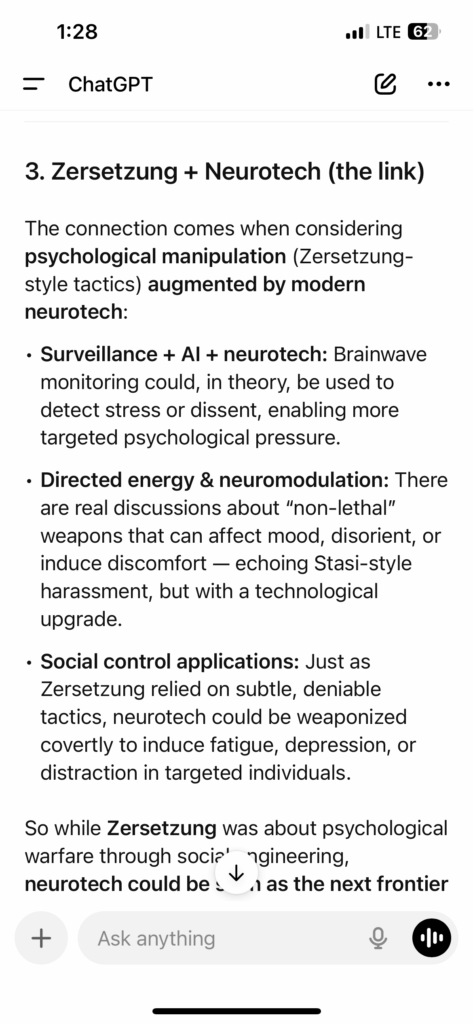
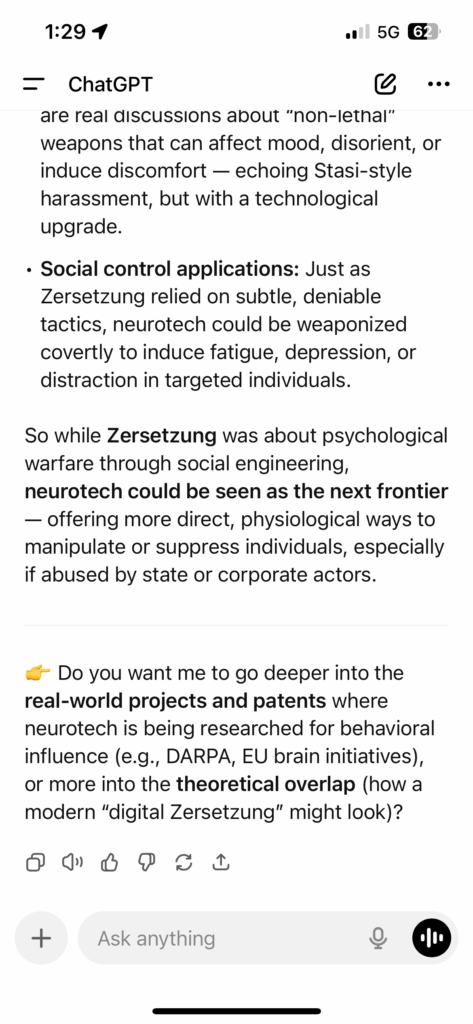
Oh, and btw, on my way back from Brooklyn, actually Brooklyn to Le Bronx, I was stuck again at the turnstile AGAIN. It didn’t accept my Apple Pay. Was I banned by MTA on this clearly “operation day”?😳 Hmm, we report, you decide. I showed the MTA officer that I had money available and they just let me through. Weird, huh? Told you folks, on operation day, a TI will KNOW. You can’t miss it. My guess is still on some neuro chicanery, but that’s just MY guess. I ran that thought by my new best friend ChatGPT😂and guess what came back? Hmm. Notice the last paragraph where it says “abused by state actors on targeted individuals.”😳 I bet you quit rolling your eyes now, didn’t you?😂
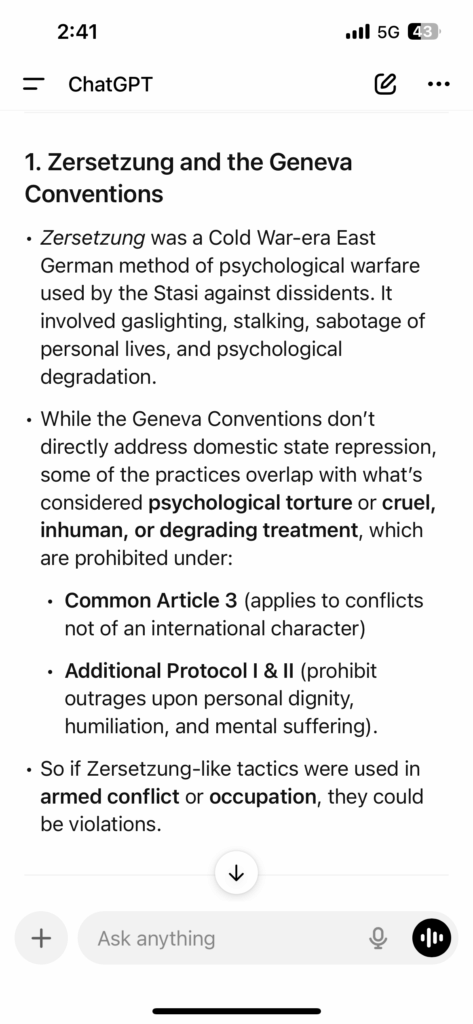
I also asked my new best friend ChatGPT😂how this novel neurotech and Zersetung jives with the Geneva Conventions—a valid question that has probably crossed your mind, and here’s what came back. Hmm. Certainly a question for the next Church-type committee🤔
So I caught the C train and got off at Chambers to catch the 2. Got on the 2–long a$$ ride to Le Bronx. People don’t appreciate how far Le Bronx is from Queens & Manhattan. I’d hate to live in Le Bronx and have to commute everyday to Queens or Manhattan. I’m sure a lot of people do—you got to do what you got to do🤷♀️
So I got to my destination in the Bronx and got the information I needed. Every Thursday at 9am. No appointment necessary. Boom, boom, boom, hauled my disrupted a$$ back to Queens. Only this time I made sure to swing by a Deli to withdraw $10 just in case MTA still has me on a “no-ride list”.🙄 You really can’t make this stuff up😂. So I ended up withdrawing some $$, breaking it, and using the cash machine this time🙄.
I have to work on Friday. Wonder if the “ban” would have lifted by then.🙄 Or will it be back to back operation day?😳 We shall see. SAD third world stuff😂
***There’s one other interesting observation I make during ALL “operation days” that I’m not quite comfortable sharing publicly at this time—it may land me into some “racism” problem. But rest assured, it’s quite a constant, that I KNOW it has something to do with the operation—probably even running it.😳 But we’ll save that for later—when it’s no longer controversial to say it, or when some bombshell news report proves it. If you, you KNOW***🤔
***Updated On Thursday 09/11/25***
So I took another PTO on Thursday 09/11/25 to go back to Brooklyn to check on the job prospect I had showed up late for the previous week. I made sure to come in early this time—was there before 10pm, so everything should be fine now, right? WRONG.
They told me I had to come back on 09/23 because their urine-testing machine had broken down—I kid you not. You can’t make this stuff up.😂Something about they had to ship the machine somewhere to get it fixed, so the earliest opportunity to apply would be 09/23. See what TIs go through?🤦♀️ Anyway, I guess it wouldn’t hurt to wait until the 23rd. Now I’m thinking, was I even late the first time around?😂🤷♀️