Tag: Targeted

  • Are TIs Close To An Answer Given New Havana Syndrome Decision?

    Catherine Herridge reported today that Director of National Intelligence Tulsi Gabbard has rescinded two Biden-era Intelligence Community Assessments related to Havana Syndrome and Anomalous Health Incidents (AHIs). According to Herridge’s reporting, the decision was based on concerns that the original assessments suffered from analytic bias, selectively excluded evidence, mischaracterized intelligence, and relied on what Gabbard reportedly described as an ethically flawed medical study.

    Source: https://x.com/c__herridge/status/2065142509370581071

    The significance of this decision cannot be overstated. For years, many of those who reported suffering debilitating neurological symptoms believed the government had already reached a final verdict on their cases. The prevailing intelligence assessments effectively closed the door on the possibility that a foreign adversary, a novel technology, or a directed energy weapon could be responsible for injuries experienced by diplomats, intelligence officers, military personnel, and others.

    According to Herridge’s reporting, that door has now been reopened.

    What makes this development particularly important is not that it proves any specific explanation. It does not. Rather, it challenges the assumption that the previous conclusions were beyond question. If the Director of National Intelligence has determined that the assessments suffered from analytic bias, selective use of intelligence, exclusion of contradictory evidence, and flawed methodology, then the debate surrounding Havana Syndrome has fundamentally changed. The issue is no longer whether the matter was settled. The issue is whether the original investigation itself was conducted objectively and comprehensively.

    For targeted individuals and ordinary civilians who have long claimed they were victims of directed energy attacks, this decision will likely be viewed as a major turning point. For years, many of these individuals have argued that government agencies dismissed reports of unusual symptoms, neurological injuries, cognitive decline, and other health effects without fully investigating their claims. Critics frequently pointed to the Intelligence Community’s assessments as evidence that such allegations lacked credibility. The rescission of those assessments removes a powerful argument that was often used to shut down further discussion.

    At the same time, it is important to recognize what this development does and does not establish. The reported memo does not acknowledge that directed energy weapons have been used against civilians. It does not conclude that targeted individuals are correct. It does not confirm the existence of a covert campaign against members of the public. What it does suggest is that at least some senior officials believe previous analyses may have been incomplete, biased, or insufficiently rigorous.

    For those who have long maintained that advanced technologies can be used to harm individuals without leaving obvious physical evidence, the decision may be interpreted as validation of a broader concern: that unconventional injuries and unexplained neurological symptoms deserve serious investigation rather than automatic dismissal. Even if future reviews ultimately reach different conclusions, the willingness to revisit prior findings represents a departure from the perception that the case was permanently closed.

    The story of Mike Beck, as highlighted by Herridge, further underscores why this issue continues to resonate. If an experienced counterintelligence officer who believed he had been targeted spent decades seeking answers before ultimately passing away with a Parkinson’s-like condition, many will argue that the government has an obligation to ensure every credible lead is thoroughly examined. Whether one accepts the directed energy hypothesis or not, there is broad agreement that individuals reporting serious health effects deserve an unbiased investigation.

    Ultimately, the most important consequence of this decision may be procedural rather than scientific. It signals that conclusions reached by intelligence agencies are not immune from review and that questions once considered settled can be revisited when concerns arise about the integrity of the underlying analysis. For targeted individuals and civilians who feel their experiences were dismissed, that alone will be seen as a significant development. Whether it leads to definitive proof of directed energy attacks remains unknown. But it does mean that the conversation is no longer taking place under the assumption that the matter has already been conclusively resolved.

  • TIs & Wage Theft

    Some time in April I got a new job with a security company working guess where? At some shelter😳 Is that my destiny?😂

    Anyway, as I had stated earlier, I had to get away from the Amazon job because that was strictly for voucher purposes—can’t survive in NYC on a 21 hour a week job.

    I didn’t officially quit the Amazon job because I didn’t know what to expect with the security job—I actually had very low expectations, if I’m being honest

    So I went into the security job basically as a tourist, just seeing if it’s something I wanted to do and if not, going back to Amazon while looking for something else.

    Turns out however that it’s a pretty decent company, PLUS it’s a union job, so even better. Even though I’m scheduled for 40 hours at this shelter location, there are plenty of opportunities to pick up extra shifts at other locations, or even do a double shift (16 hours) at the shelter😳 Not bad at all.

    So I did about three weeks on 40 hours to see if there would be any “issues” with my paycheck—a common problem for targeted individuals😂🤦‍♀️

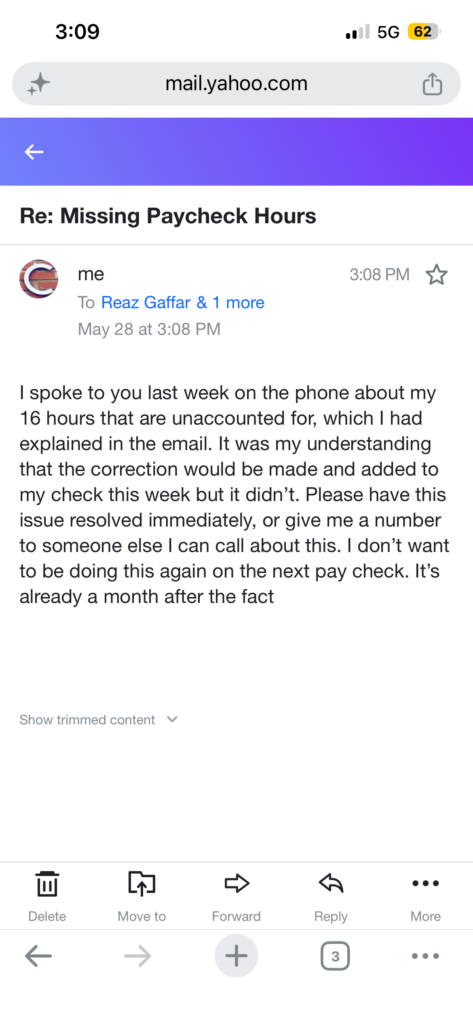
    The 40 hour work weeks went fine—no issues to report. So on the week beginning…a TI decided to kick up his game a notch, and venture into the overtime territory—just to see how the check would look with 48 hours. So I did 48 hours on the week beginning…and did the same thing for the week after that. So two weeks with 48 hours back to back.

    Next thing I know “problems” with BOTH the checks where I had overtime😂🤦‍♀️You really can’t make this stuff up. Remember I wrote about this VERY SAME issue with the Amazon job when I decided to work more than 21 hours. It’s NOT a mistake—very deliberate

    This however, is what many TIs fail to get—the psyop they fail to realize. It is NOT about the money. They do this so that the TI begins to associate overtime with problems, so the YOU YOU YOU the TI begins to shy away from overtime—Why should I do overtime when I’m not even going to get paid? You get it?🤔 Everything is fine UNTIL the TI starts going for overtime. They want you earning survival money, not thriving money

    Anyway, even though this issue is from the week in the beginning of May, they still haven’t fixed it even as we’re heading into June. A TI’s 16 hours of wages just STOLEN. Sad.

    Most TIs are also broke—living paycheck to paycheck, so issues like this can really disrupt their work, even though they haven’t done anything wrong. Luckily for me, I’m not that broke, so I have the luxury of waiting for my money without getting in anybody’s face. Nobody should be chasing anybody down for their paycheck like this, though—TI or no TI. Matter of fact, isn’t that a crime?😂🤷‍♀️

    Anyway, my plan is to hang around at this shelter location for a little longer then request a move to another site. I don’t want to “rock the boat” too early. I can tell you right now, things are not going to end well here if I have to do this “catch me if you can” routine with my paycheck every time I have some overtime.😂

    I’ll keep you posted on paycheckgate.

    Also wanted to point out that my plan this year, after securing an apartment, was to start writing a book—you read that right—a book about my experiences as a TI. The website doesn’t do TIs a lot of justice because often times it describes incidents that can be dismissed as one-offs, even though they are not. A book with actual chapters and paragraphs will do a better job, imho, laying out how the TI program works. So if you don’t see a lot of posts from me this year, just know that I’m putting them into a book. Only fragrant incidents like this paycheckgate will appear on this website.😂

  • Is This Proof That Regular Civilians Are Also Attacked By DEWs?

    A remarkable and deeply controversial claim is now circulating after a New York Post report highlighted the story of journalist Alisa Valdes-Rodriguez, who says she is leaving the United States after allegedly experiencing what she describes as “directed energy weapons” attacks connected to her reporting on Jeffrey Epstein and his New Mexico network. According to the article, Valdes-Rodriguez believes she suffered symptoms resembling what has often been referred to as “Havana syndrome,” a term tied to mysterious neurological incidents reported by diplomats, intelligence officers, and other government personnel.

    For years, discussions surrounding directed energy weapons and Havana syndrome have largely been confined to the world of intelligence agencies, embassies, military operations, and classified national security conversations. Governments, particularly in the United States, have generally framed the issue as one affecting diplomats, CIA personnel, or other officials operating overseas. The public narrative has consistently suggested that these incidents are rare, specialized, and tied to geopolitical conflict. That framing has frustrated many so-called “targeted individuals,” ordinary civilians who have long argued that similar technologies or tactics can also be used domestically against non-governmental people.

    Valdes-Rodriguez’s claims are now drawing attention precisely because she does not fit the traditional profile that officials have usually associated with these alleged attacks. She is not a diplomat stationed abroad. She is not an intelligence officer operating in a hostile foreign capital. She is a journalist and author who says her work investigating Epstein’s New Mexico connections placed her in dangerous territory. Whether people believe her claims or not, the significance lies in the fact that a mainstream media outlet is reporting on a civilian making allegations that resemble the same kinds of symptoms and experiences previously associated almost exclusively with government personnel.

    That matters because targeted individuals have spent years arguing that the public conversation surrounding directed energy weapons has been artificially narrow. Many of them believe the government has dismissed or ignored civilians who report neurological symptoms, unexplained auditory phenomena, pressure sensations, sleep disruption, cognitive issues, or other unusual experiences. Critics have often labeled such claims as paranoia or conspiracy theories, particularly when they come from ordinary citizens without institutional backing. Yet when diplomats reported similar symptoms, the issue suddenly became a matter of congressional hearings, intelligence reviews, and national security investigations.

    The contradiction has fueled enormous anger within targeted individual communities. Their argument has always been simple: if advanced technologies capable of affecting the human body exist at all, why would civilians automatically be excluded as possible targets? From their perspective, the government’s position has appeared inconsistent. On one hand, officials acknowledge mysterious neurological incidents affecting American personnel overseas. On the other hand, civilians making similar allegations are frequently dismissed outright before any serious inquiry occurs.

    The Valdes-Rodriguez story is therefore being interpreted by some as a potential crack in that wall of skepticism. Again, none of this proves her allegations are true, nor does it independently verify the existence of a domestic directed energy campaign against civilians. But the mere fact that a journalist connected to high-profile Epstein reporting is publicly describing experiences she believes are linked to directed energy attacks gives new visibility to a conversation that has long existed on the fringes.

    The Epstein angle also intensifies public intrigue because his network has remained the subject of endless speculation regarding intelligence ties, elite protection systems, blackmail operations, and institutional failures. Whenever someone connected to investigating Epstein makes alarming claims, those claims inevitably attract attention far beyond the usual audience interested in Havana syndrome debates. That combination — Epstein, intelligence speculation, and alleged directed energy attacks — creates a story that many people will view through the lens of secrecy and distrust toward powerful institutions.

    Skeptics will naturally argue there is still no publicly verified evidence proving that civilians are being targeted with directed energy weapons inside the United States. They will point to psychological explanations, environmental factors, stress responses, or misinformation spreading online. Others, however, will argue that history shows governments often acknowledge controversial technologies only years after denying or minimizing them. To those people, the Valdes-Rodriguez story reinforces the belief that the official narrative surrounding Havana syndrome and related phenomena may be incomplete.

    What cannot be denied is that the conversation itself is evolving. A topic once limited to intelligence briefings and diplomatic circles is increasingly spilling into mainstream media discussions involving journalists, activists, and private citizens. Whether one sees that as validation, speculation, or something in between, stories like this ensure that the debate over directed energy weapons and civilian targeting is unlikely to disappear anytime soon.

  • House Hearing Set For MKULTRA

    Rep Anna Paulina Luna (R-FL) recently posted on X that a House hearing on MKULTRA has officially been set for 05/13/2026.

    This will come as welcome news to targeted individuals who have for years contended that such programs never really ended, and that part of their targeting has to do with non consensual human experimentation, not very different from what occurred under MKULTRA

    It will be interesting to see how the 05/13 hearings play out but my bigger hope is that it acts as a door opener to more such hearings regarding classified ills of the past.

    Rep Luna should be commended for having the courage to touch a topic that most of her colleagues would not dare touch

  • Was UFO Scientist Killed Using Directed Energy Weapons?

    The post circulating on X, attributed to Congressman Eric Burlison, does something that the mainstream conversation around this topic has long resisted: it cracks open the door, however slightly, to the possibility that claims dismissed for years may not be as easily waved away as “conspiracy theories.” When a sitting member of Congress goes on Fox News and says a death “should be investigated” in connection with a directed energy weapon, that is not fringe internet chatter—it’s a signal that these ideas have moved into institutional discourse.

    For decades, individuals who identify as “targeted” have described patterns of harassment, surveillance, and in some cases, alleged attacks using technologies they could not fully explain. These accounts have been overwhelmingly dismissed by major media outlets and often pathologized rather than examined. The label of “conspiracy theory” has functioned less as a conclusion and more as a barrier, shutting down inquiry before it begins. Yet here we have Burlison referencing testimony involving Michael Shellenberger and information from Franc Milburn—names that carry institutional weight, not anonymous message board users.

    What makes this moment notable is not that it proves the existence of targeted directed energy attacks, but that it disrupts the long-standing narrative that such claims are inherently unserious. When discussions like this enter congressional hearings and televised interviews, they gain a legitimacy that forces a shift in how they are perceived. Even the act of calling for an investigation implies that the allegation clears a basic threshold of plausibility—otherwise, it would not be raised in that setting at all.

    There is also a broader context that cannot be ignored. Advanced military technologies have historically existed years, sometimes decades, ahead of what is publicly acknowledged. Programs once considered speculative have later been confirmed, often after sustained public denial. This pattern fuels skepticism toward blanket dismissals. While directed energy weapons are publicly known in limited forms, the full scope of their capabilities—especially in classified environments—remains largely opaque. That opacity creates space where claims from targeted individuals, once ridiculed, begin to feel less easily dismissed.

    The media’s longstanding approach has been to frame these reports as fringe beliefs, often without deeply engaging with the underlying assertions. But when a public official references a specific case—Amy Eskridge—and connects it to testimony and intelligence-linked sources, it complicates that framing. It suggests that, at minimum, there are questions being asked in places of power that mirror what individuals have been saying for years.

    This does not mean every claim made by self-identified targeted individuals is accurate or that all interpretations of their experiences are correct. But it does mean the conversation is shifting. The gap between what is considered “unthinkable” and what is considered “worth investigating” is narrowing, and that shift alone changes the landscape. Once a topic enters that space, it becomes harder to dismiss outright and easier to examine with a more open, if still critical, lens.

    What we are witnessing may be the early stages of a broader reevaluation—one where claims that were previously marginalized begin to receive at least partial acknowledgment, not as established truth, but as subjects that can no longer be ignored.

  • Rep Lauren Boebert Promises To Dig Into MKULTRA

    The comments from Lauren Boebert about the CIA’s infamous MKUltra program tap into something that has lingered in the American psyche for decades: a deep unease about what the intelligence community is capable of doing in secret—and whether the public ever truly gets the full story once those secrets are exposed. Notably, these remarks surfaced in an interview she gave to Benny Johnson, which he later highlighted in a post on X. Her suggestion that MKUltra may not have definitively ended, but instead evolved or continued under a different framework, is not a new theory, but it is one that continues to resonate in an era of declining institutional trust.

    To understand why her remarks are gaining traction, it’s important to revisit what MKUltra actually was. Beginning in the early 1950s during the height of the Cold War, the Central Intelligence Agency launched a covert program aimed at exploring mind control, interrogation techniques, and behavioral manipulation. Experiments often involved psychoactive substances like LSD, sometimes administered without the knowledge or consent of subjects. The program remained hidden until the 1970s, when a series of investigations—including the Church Committee hearings—brought it to light. What followed was public outrage, official condemnation, and assurances that such abuses had been halted.

    But those assurances have always come with caveats. Much of the MKUltra documentation was deliberately destroyed in 1973, which means that even today, the full scope of the program is not known. That gap in the historical record is precisely what fuels ongoing suspicion. When Boebert questions whether there was ever a “hard line” shutting the program down, she is leaning into a very real fact: oversight bodies confirmed abuses, but could not reconstruct the entirety of what happened, nor definitively rule out the continuation of similar research under different names or authorities.

    Her speculation about modern equivalents—using newer drugs or advanced technologies—reflects a broader concern about how intelligence agencies adapt. The tools available today, from neurotechnology to AI-driven behavioral analysis, are far more sophisticated than anything that existed during the Cold War. While there is no public evidence that MKUltra-style experiments are ongoing, the capabilities that governments now possess make the question feel less far-fetched to some observers. That’s where the debate shifts from historical accountability to present-day transparency.

    At the same time, it’s worth separating what is documented from what is conjecture. Officially, MKUltra was halted in the early 1970s, and subsequent reforms were put in place to increase oversight of intelligence activities. Congressional committees, inspector generals, and legal frameworks were strengthened in response to the very abuses uncovered during that era. There has been no verified disclosure showing that MKUltra—or a direct successor program involving non-consensual human experimentation—continues today. Suggesting that it does requires a leap beyond the available evidence, even if it draws energy from legitimate past wrongdoing.

    Still, Boebert’s call for renewed scrutiny is part of a larger, bipartisan undercurrent in American politics: skepticism toward secretive government power. Whether it’s surveillance authorities, covert operations, or classified research, lawmakers across the spectrum have periodically pushed for more transparency from agencies like the CIA. The tension is structural. Intelligence agencies argue that secrecy is essential to national security, while critics counter that secrecy without accountability invites abuse.

    The enduring legacy of MKUltra complicates that balance. It serves as a documented example of how far government programs can drift when shielded from scrutiny, and how difficult it can be to fully reckon with those actions after the fact. Even decades later, the lack of complete records means that definitive closure is elusive. That ambiguity leaves space for both reasonable skepticism and more speculative claims to coexist.

    What Boebert is effectively doing is channeling that ambiguity into a political argument: that unanswered questions justify renewed investigation. Whether that leads to substantive findings or simply reopens an old chapter will depend on what, if anything, remains hidden in classified archives. But her remarks—amplified through her conversation with Johnson and his subsequent social media post—underscore a reality that extends far beyond MKUltra itself: the public’s demand to know where the boundaries of government power truly lie, and whether those boundaries are being respected in ways that can be independently verified.

  •  Directed Energy, Havana Syndrome, and the Thin Line Between Dismissal and Disclosure

    The viral post circulating on X from Furkan Gözükara makes a dramatic claim: that the Pentagon is preparing to deploy a “soft kill” microwave weapon on Black Hawk helicopter platforms, capable of directing pulsed energy into the human skull with devastating physiological effects. Taken at face value, it reads like something out of speculative fiction. Yet what gives the claim unusual traction is not necessarily the credibility of the source, but how closely it echoes long-standing allegations from so-called “targeted individuals,” as well as the still-unresolved mystery surrounding Havana Syndrome.

    For years, individuals claiming to be targeted by directed energy weapons have described symptoms that sound eerily similar to those reported in Havana Syndrome cases: intense head pressure, disorientation, auditory sensations, and neurological disruption without visible external cause. These accounts have typically been dismissed by mainstream institutions as psychological or conspiratorial. However, the emergence of credible government concern over Havana Syndrome—impacting diplomats, intelligence officers, and military personnel—has complicated that narrative. The U.S. government has acknowledged that something real is happening, even if the precise mechanism remains contested.

    This is where the tension becomes difficult to ignore. If directed energy technologies capable of affecting the human nervous system are even theoretically plausible—and there is open-source research suggesting that microwave or radiofrequency energy can interact with biological tissue—then the categorical dismissal of civilians making similar claims begins to look less like certainty and more like institutional reflex. The question is no longer whether such technologies could exist in principle, but rather who possesses them, how advanced they are, and under what conditions they are deployed or tested.

    At the same time, it’s important to separate what is publicly verified from what is speculative. There is no confirmed evidence that the Pentagon is deploying a weapon exactly as described in the X post, nor that such systems are being actively tested in Iran. Military research into directed energy systems—such as high-powered microwaves or laser-based tools—has been ongoing for decades, often framed in terms of disabling electronics or non-lethal crowd control rather than directly targeting human biology in the extreme manner described. That distinction matters, because it highlights how quickly a kernel of truth (ongoing research into advanced weapons) can be amplified into a far more sensational claim.

    Still, the overlap in language and effects between alleged “soft kill” systems and Havana Syndrome symptoms raises a legitimate question: if the U.S. government is seriously investigating the possibility that personnel were affected by directed energy attacks, why is the focus so heavily placed on foreign adversaries? Intelligence assessments have pointed to countries like Russia or China as potential culprits, but critics argue that this framing conveniently avoids scrutiny of domestic capabilities or classified programs. In other words, if such weapons exist, the assumption that only “bad actors” would use them may be more political than evidentiary.

    This dynamic creates a credibility gap. On one side are officials urging caution and emphasizing the lack of definitive proof. On the other are individuals—both civilians and government personnel—reporting consistent, sometimes debilitating experiences that defy easy explanation. When the government validates one group’s experiences (diplomats) while continuing to dismiss another’s (targeted individuals), it inevitably fuels suspicion that the line between acknowledgment and denial is being drawn selectively.

    None of this proves that the claims in the viral post are accurate, nor that targeted individuals’ accounts are definitively caused by directed energy weapons. But it does underscore a broader issue: the boundaries of what is considered “possible” have shifted. Technologies once relegated to the fringe are now openly studied, funded, and in some cases deployed in limited forms. As that boundary moves, so too must the willingness to reexamine past assumptions—especially when those assumptions involve dismissing people outright.

    In that sense, the real significance of posts like this one is not whether every detail holds up under scrutiny, but how they intersect with an evolving public conversation about secrecy, emerging weapons, and the credibility of lived experience. The Havana Syndrome investigation has already forced a partial reckoning. Whether it leads to a deeper, more transparent understanding—or reinforces existing narratives about external threats—will likely shape how seriously these overlapping claims are taken going forward.

  • Ray Of Sunlight For Targeted Individuals?


    “Classification should protect national security, not cover up illegal actions.” That single sentence, coming from a sitting member of Congress, carries more weight than it might seem at first glance. It is not merely a comment about UFOs or UAPs; it is a statement that cuts to the core of how power is supposed to function in a constitutional democracy. For individuals who believe they have been targeted, surveilled, or otherwise affected by undisclosed government programs—especially those funded through opaque “black budgets”—this kind of public acknowledgment can feel like a rare crack in an otherwise impenetrable wall. It signals that at least some within the system recognize the potential for abuse when secrecy becomes untethered from accountability.

    Historically, black budget programs have existed precisely to shield sensitive national security efforts from adversaries. That is their legitimate purpose. However, history also shows that secrecy, when left unchecked, can evolve into a mechanism not just for protection, but for concealment—of mistakes, overreach, and even outright violations of law. From covert surveillance programs later deemed unconstitutional to clandestine operations that sidestepped congressional oversight, there is a documented pattern: the more insulated a program is from scrutiny, the greater the risk that it drifts away from its stated mission. This is why the Congressman’s statement resonates beyond the specific context of UAP investigations. It reframes secrecy as a tool with limits, not an absolute shield.

    For those who believe they have been affected by classified programs, the statement offers something that has often been missing—validation of principle, if not yet of specific claims. It acknowledges that classification can be misused, and that misuse is not hypothetical but historically grounded. Even without confirming any individual case, the idea that secrecy should never be a refuge for illegality provides a foundation for legitimate inquiry. It suggests that questioning the scope and conduct of black budget programs is not inherently fringe or conspiratorial, but aligned with the responsibilities of democratic oversight.

    At a broader level, the existence of programs operating with “zero accountability” stands in direct tension with the basic structure of a free society. Democracies depend on informed consent of the governed, which in turn requires transparency—or at least the possibility of it. While not every detail of national security can be public, there must be mechanisms through which elected representatives, courts, or independent watchdogs can evaluate whether those programs adhere to the law. When programs are so deeply classified that even meaningful oversight becomes impossible, they effectively exist outside the constitutional framework. That is not a technical flaw; it is a structural contradiction.

    The danger is not only theoretical. If a program can operate indefinitely without oversight, it can develop its own internal logic, priorities, and justifications, detached from the public interest. In such an environment, individuals could be affected—directly or indirectly—without recourse, without explanation, and without the ability to challenge what is being done. Whether one believes specific claims of targeting or not, the underlying concern is valid: systems that lack transparency and accountability create conditions where abuse can occur and persist. That is precisely why democratic societies place such emphasis on checks and balances.

    The Congressman’s statement also implicitly challenges a cultural tendency within government institutions to equate secrecy with necessity. Not everything that is classified is essential to national security; sometimes it is simply inconvenient to disclose. By drawing a line between protection and concealment, the statement invites a reevaluation of what should remain hidden and why. It suggests that classification should be narrowly tailored and rigorously justified, not broadly applied as a default. For those concerned about black budget programs, this is a crucial distinction, because it opens the door to the idea that some currently hidden activities may not meet that standard.

    In this sense, the statement serves as a kind of institutional acknowledgment that reform is both possible and necessary. It does not dismantle secrecy, nor does it deny the need for it, but it insists that secrecy must coexist with accountability. That balance is what separates a functioning democracy from a system where power operates unchecked. For individuals seeking answers about programs they believe have affected them, this perspective offers a path forward—not necessarily immediate disclosure, but the possibility of oversight, investigation, and, ultimately, truth.

    What makes this moment significant is not that it resolves long-standing concerns, but that it reframes them. It shifts the conversation from whether such programs exist or whether individuals are justified in questioning them, to whether the principles of governance are being upheld. In doing so, it provides a measure of legitimacy to calls for transparency and accountability. Even if the road to full disclosure is long and uncertain, the acknowledgment that classification should never be used to hide illegality is a meaningful step. It is, in a very real sense, a ray of sunlight—small, perhaps, but powerful enough to illuminate the edges of a system that has operated in the dark for far too long.

  • Havana Syndrome Goes Mainstream

    Television show on Prime Video had its first episode of its first season based on Havana Syndrome and directed energy weapons

    Clearly shows that the topic has over from the “conspiracy theory” realm into a real national security threat discussion.

    Importantly, the attacks happen on regular civilians working at an office that handles sensitive government contracts. The narrative from the government has always been that the attacks are only aimed at government officials in the intelligence community.

    The show however depicts rogue South American actors attacking a private company in the United States

    Hopefully this will lead to some concrete action from Congress regarding the real threat these weapons pose, and importantly how these new weapons also threaten regular civilians

  • Income Tax Drama

    2025 income tax refund is finally here, and yay, it’s a lot of $$ this time, quite a decent amount.

    But guess what—you knew there had to be a but😂🙄—the IRS deducted $3500, yeah you read that right, deducted $3500 and gave it to my baby mama even though I’ve had the two kids since late 2023

    They did the SAME thing with the previous tax return. I wrote about it here but the website got shut down by malware shortly thereafter. Weird huh?🙄

    Think about that for a second. A targeted individual is someone the Feds follow everywhere, everyday, every hour but somehow, the IRS “doesn’t know” that he has had the kids since 2023? If you believe that, I’ve got a bridge for sale😂

    Moral of the story is they are constantly STEALING from TIs, yes I said that, stealing. They deliberately do that knowing you will NOT recoup the entire $3500–your earned, rightful money. You may get some back, but not the entire $3500. And then after that they start getting after the rest of your stash—chip away at it slowly by slowly. The $3500 is just the start.🤔

    Remember the goal is to keep the TI living paycheck to paycheck with zero financial cushion. That’s their sweet spot. Stay tuned

    The $3500 was supposed to be sent out by IRS on Monday 03/09/26, but as of today, Friday 03/13/26 she has NOT seen any of it. Now whether that’s true or not, there’s no way for me to verify, but you get the point. This is a targeted individual’s hard earned money which so far looks like will just get STOLEN from him, or even if he gets it, it will NOT be the full amount.

    You’ve heard about TIs complaining about government criminals and their minions STEALING from them. Well, here’s your slam dunk example. We’ll give them a little more time—one more week—but, not looking good🤷‍♀️

    **Update On Income Tax Drama 032526**

    So as of Wednesday 03/26/26 Baby Mama says she STILL has not received the money IRS took from me and sent to Texas on 03/09/26🙄. She says she called Austin (child support office) and was told that the IRS stood on business and sent the money to them on 03/09/26–exactly as it says on my IRS account. 

    According to her, the folks in Austin told her it will take 4-8 WEEKS before the money hits her bank. No, I didn’t stutter, not 4-8 days, 4-8 WEEKS. 

    Now, let’s analyze this situation for a second. This is not the first time IRS has sent my tax refund to Austin. They did so with the 2024 tax refund too. In that case, according to my IRS account, the deducted funds were sent to Austin on 03/10/25. Baby Mama had the $$ on 03/12/25. Nobody said anything about 4-8 WEEKS for processing🤔

    And even putting that aside. What would be the point of taking money from somebody’s tax refund and then just have it sit at the AG’s office in Austin? Shouldn’t they be moving heaven and earth to make sure the “custodial parent” get some much needed financial relief?🤔

    Aaahaa!! Therein lies your answer. It was never about that. It was ALWAYS about robbing the TI. Crooked Ken Paxton’s office took money from a TI they had no business taking, and now they are just sitting on it in Austin

    Just goes to show you folks, TIs are not as 🦇 💩 crazy as they would have you believe. When you analyze this stuff closely, the targeting is all out there for you to see🤔

    Stay tuned. I’ll keep you posted as this drama plays out

    **Update on income tax drama on tax day 041526**

    So on Wednesday 041526—tax day—I decided to inquire into the missing $3,500 that IRS took from my refund. I have an online IRS account that I check regularly for notices, but they never put the notice there. Most likely they mailed it to an old address🙄

    So on 041526 I actually called the IRS inquiring about this $3,500 deduction and came out with some, let’s just say, interesting discovery. The IRS folks directed me to the Bureau of Fiscal Services (BFS), and gave me a number to call for details about the $3,500. The actual figure is $3,521.

    So I called BFS and was pleasantly surprised to find out that it’s actually a straightforward process. You don’t even need to speak to a live person. You just call the number, it asks for your social and other identifying info and all the information is available via voice prompts—“press 1 for details of the debt” etc.

    So I followed through with the voice prompts and found out that the $3,521 was sent to two agencies—The Louisiana Department of Revenue (basically Louisiana’s IRS) and, you guessed it, the Texas Attorney Genenal’s Office(child support). Roughly two thirds went to Texas AG’s office and a third to Louisiana

    Now, the Louisiana debt is a legit debt from before 2020–I want to say 2018 or 2019. I had taken a refinery job in Louisiana but when the tax filing season came, I just filed my federal taxes and did not file the Louisiana state taxes as was required. I remember them sending me notices to my Texas address for some $500 that I owed the state. My assumption was that they would just take that $500 from any subsequent income tax that I filed, but apparently they never did so until 2026, some 7-8 years later. Kinda weird, but hey. The amount they took was also way more than $500, which I’m assuming is late charges plus collection fees.🙄

    So because Louisiana was actually a legit debt, I never called them to inquire about the amount they took. Seemed a little high to me, plus a little out of the blue (could have collected long ago, especially during the COVID cash boom😂) but hey, it is what it is.

    So that leaves us with MAGA corrupt Texas AG’s office, who got the large chunk of the $3521 and like I said earlier, has ZERO claim on the money. None. They KNOW the children have lived with their dad in NY for two plus years but STILL conspires to STEAL his income tax refund every tax season. Yeah, you heard that right, I didn’t stutter—conspire to STEAL a targeted individual’s tax refund—a CRIME

    Luckily, this is an issue that targeted individuals have raised for years, and is now catching steam even with some members of Congress—-these, so called “covert operations” that are basically organized crimes that serve no national security purposes. I wrote about this in a previous post. Make no mistake about it, theft is the “covert operation” in this case. But it’s classified, so you can’t do anything about it. Total travesty that has nothing to do with national security.

    But anyway, this is the story I got on 041526 from the Texas AG’s office. The money that—according to Baby Mama—was still being held by the Texas AG’s office for some 4-8 weeks WAS ALREADY PAID OUT on 03/10/26. You read that right. A TI is being fed all these stories while his money was already stolen a long time ago. Now you see what I mean when I say CONSPIRE TO STEAL. It’s not just some arbitrary term I’m throwing out there, it’s exactly that.

    But stay tuned, this might be a great opportunity to raise this classified crimes issue in a Texas court. I’m working on it. I also have to make sure the crooks don’t steal my next tax refund too, so court action may be inevitable.🤔 Stay tuned.