Tag: Gangstalking

  • House Hearing Set For MKULTRA

    Rep Anna Paulina Luna (R-FL) recently posted on X that a House hearing on MKULTRA has officially been set for 05/13/2026.

    This will come as welcome news to targeted individuals who have for years contended that such programs never really ended, and that part of their targeting has to do with non consensual human experimentation, not very different from what occurred under MKULTRA

    It will be interesting to see how the 05/13 hearings play out but my bigger hope is that it acts as a door opener to more such hearings regarding classified ills of the past.

    Rep Luna should be commended for having the courage to touch a topic that most of her colleagues would not dare touch

  • Ray Of Sunlight For Targeted Individuals?


    “Classification should protect national security, not cover up illegal actions.” That single sentence, coming from a sitting member of Congress, carries more weight than it might seem at first glance. It is not merely a comment about UFOs or UAPs; it is a statement that cuts to the core of how power is supposed to function in a constitutional democracy. For individuals who believe they have been targeted, surveilled, or otherwise affected by undisclosed government programs—especially those funded through opaque “black budgets”—this kind of public acknowledgment can feel like a rare crack in an otherwise impenetrable wall. It signals that at least some within the system recognize the potential for abuse when secrecy becomes untethered from accountability.

    Historically, black budget programs have existed precisely to shield sensitive national security efforts from adversaries. That is their legitimate purpose. However, history also shows that secrecy, when left unchecked, can evolve into a mechanism not just for protection, but for concealment—of mistakes, overreach, and even outright violations of law. From covert surveillance programs later deemed unconstitutional to clandestine operations that sidestepped congressional oversight, there is a documented pattern: the more insulated a program is from scrutiny, the greater the risk that it drifts away from its stated mission. This is why the Congressman’s statement resonates beyond the specific context of UAP investigations. It reframes secrecy as a tool with limits, not an absolute shield.

    For those who believe they have been affected by classified programs, the statement offers something that has often been missing—validation of principle, if not yet of specific claims. It acknowledges that classification can be misused, and that misuse is not hypothetical but historically grounded. Even without confirming any individual case, the idea that secrecy should never be a refuge for illegality provides a foundation for legitimate inquiry. It suggests that questioning the scope and conduct of black budget programs is not inherently fringe or conspiratorial, but aligned with the responsibilities of democratic oversight.

    At a broader level, the existence of programs operating with “zero accountability” stands in direct tension with the basic structure of a free society. Democracies depend on informed consent of the governed, which in turn requires transparency—or at least the possibility of it. While not every detail of national security can be public, there must be mechanisms through which elected representatives, courts, or independent watchdogs can evaluate whether those programs adhere to the law. When programs are so deeply classified that even meaningful oversight becomes impossible, they effectively exist outside the constitutional framework. That is not a technical flaw; it is a structural contradiction.

    The danger is not only theoretical. If a program can operate indefinitely without oversight, it can develop its own internal logic, priorities, and justifications, detached from the public interest. In such an environment, individuals could be affected—directly or indirectly—without recourse, without explanation, and without the ability to challenge what is being done. Whether one believes specific claims of targeting or not, the underlying concern is valid: systems that lack transparency and accountability create conditions where abuse can occur and persist. That is precisely why democratic societies place such emphasis on checks and balances.

    The Congressman’s statement also implicitly challenges a cultural tendency within government institutions to equate secrecy with necessity. Not everything that is classified is essential to national security; sometimes it is simply inconvenient to disclose. By drawing a line between protection and concealment, the statement invites a reevaluation of what should remain hidden and why. It suggests that classification should be narrowly tailored and rigorously justified, not broadly applied as a default. For those concerned about black budget programs, this is a crucial distinction, because it opens the door to the idea that some currently hidden activities may not meet that standard.

    In this sense, the statement serves as a kind of institutional acknowledgment that reform is both possible and necessary. It does not dismantle secrecy, nor does it deny the need for it, but it insists that secrecy must coexist with accountability. That balance is what separates a functioning democracy from a system where power operates unchecked. For individuals seeking answers about programs they believe have affected them, this perspective offers a path forward—not necessarily immediate disclosure, but the possibility of oversight, investigation, and, ultimately, truth.

    What makes this moment significant is not that it resolves long-standing concerns, but that it reframes them. It shifts the conversation from whether such programs exist or whether individuals are justified in questioning them, to whether the principles of governance are being upheld. In doing so, it provides a measure of legitimacy to calls for transparency and accountability. Even if the road to full disclosure is long and uncertain, the acknowledgment that classification should never be used to hide illegality is a meaningful step. It is, in a very real sense, a ray of sunlight—small, perhaps, but powerful enough to illuminate the edges of a system that has operated in the dark for far too long.

  • Havana Syndrome Goes Mainstream

    Television show on Prime Video had its first episode of its first season based on Havana Syndrome and directed energy weapons

    Clearly shows that the topic has over from the “conspiracy theory” realm into a real national security threat discussion.

    Importantly, the attacks happen on regular civilians working at an office that handles sensitive government contracts. The narrative from the government has always been that the attacks are only aimed at government officials in the intelligence community.

    The show however depicts rogue South American actors attacking a private company in the United States

    Hopefully this will lead to some concrete action from Congress regarding the real threat these weapons pose, and importantly how these new weapons also threaten regular civilians

  • Income Tax Drama

    2025 income tax refund is finally here, and yay, it’s a lot of $$ this time, quite a decent amount.

    But guess what—you knew there had to be a but😂🙄—the IRS deducted $3500, yeah you read that right, deducted $3500 and gave it to my baby mama even though I’ve had the two kids since late 2023

    They did the SAME thing with the previous tax return. I wrote about it here but the website got shut down by malware shortly thereafter. Weird huh?🙄

    Think about that for a second. A targeted individual is someone the Feds follow everywhere, everyday, every hour but somehow, the IRS “doesn’t know” that he has had the kids since 2023? If you believe that, I’ve got a bridge for sale😂

    Moral of the story is they are constantly STEALING from TIs, yes I said that, stealing. They deliberately do that knowing you will NOT recoup the entire $3500–your earned, rightful money. You may get some back, but not the entire $3500. And then after that they start getting after the rest of your stash—chip away at it slowly by slowly. The $3500 is just the start.🤔

    Remember the goal is to keep the TI living paycheck to paycheck with zero financial cushion. That’s their sweet spot. Stay tuned

    The $3500 was supposed to be sent out by IRS on Monday 03/09/26, but as of today, Friday 03/13/26 she has NOT seen any of it. Now whether that’s true or not, there’s no way for me to verify, but you get the point. This is a targeted individual’s hard earned money which so far looks like will just get STOLEN from him, or even if he gets it, it will NOT be the full amount.

    You’ve heard about TIs complaining about government criminals and their minions STEALING from them. Well, here’s your slam dunk example. We’ll give them a little more time—one more week—but, not looking good🤷‍♀️

    **Update On Income Tax Drama 032526**

    So as of Wednesday 03/26/26 Baby Mama says she STILL has not received the money IRS took from me and sent to Texas on 03/09/26🙄. She says she called Austin (child support office) and was told that the IRS stood on business and sent the money to them on 03/09/26–exactly as it says on my IRS account. 

    According to her, the folks in Austin told her it will take 4-8 WEEKS before the money hits her bank. No, I didn’t stutter, not 4-8 days, 4-8 WEEKS. 

    Now, let’s analyze this situation for a second. This is not the first time IRS has sent my tax refund to Austin. They did so with the 2024 tax refund too. In that case, according to my IRS account, the deducted funds were sent to Austin on 03/10/25. Baby Mama had the $$ on 03/12/25. Nobody said anything about 4-8 WEEKS for processing🤔

    And even putting that aside. What would be the point of taking money from somebody’s tax refund and then just have it sit at the AG’s office in Austin? Shouldn’t they be moving heaven and earth to make sure the “custodial parent” get some much needed financial relief?🤔

    Aaahaa!! Therein lies your answer. It was never about that. It was ALWAYS about robbing the TI. Crooked Ken Paxton’s office took money from a TI they had no business taking, and now they are just sitting on it in Austin

    Just goes to show you folks, TIs are not as 🦇 💩 crazy as they would have you believe. When you analyze this stuff closely, the targeting is all out there for you to see🤔

    Stay tuned. I’ll keep you posted as this drama plays out

    **Update on income tax drama on tax day 041526**

    So on Wednesday 041526—tax day—I decided to inquire into the missing $3,500 that IRS took from my refund. I have an online IRS account that I check regularly for notices, but they never put the notice there. Most likely they mailed it to an old address🙄

    So on 041526 I actually called the IRS inquiring about this $3,500 deduction and came out with some, let’s just say, interesting discovery. The IRS folks directed me to the Bureau of Fiscal Services (BFS), and gave me a number to call for details about the $3,500. The actual figure is $3,521.

    So I called BFS and was pleasantly surprised to find out that it’s actually a straightforward process. You don’t even need to speak to a live person. You just call the number, it asks for your social and other identifying info and all the information is available via voice prompts—“press 1 for details of the debt” etc.

    So I followed through with the voice prompts and found out that the $3,521 was sent to two agencies—The Louisiana Department of Revenue (basically Louisiana’s IRS) and, you guessed it, the Texas Attorney Genenal’s Office(child support). Roughly two thirds went to Texas AG’s office and a third to Louisiana

    Now, the Louisiana debt is a legit debt from before 2020–I want to say 2018 or 2019. I had taken a refinery job in Louisiana but when the tax filing season came, I just filed my federal taxes and did not file the Louisiana state taxes as was required. I remember them sending me notices to my Texas address for some $500 that I owed the state. My assumption was that they would just take that $500 from any subsequent income tax that I filed, but apparently they never did so until 2026, some 7-8 years later. Kinda weird, but hey. The amount they took was also way more than $500, which I’m assuming is late charges plus collection fees.🙄

    So because Louisiana was actually a legit debt, I never called them to inquire about the amount they took. Seemed a little high to me, plus a little out of the blue (could have collected long ago, especially during the COVID cash boom😂) but hey, it is what it is.

    So that leaves us with MAGA corrupt Texas AG’s office, who got the large chunk of the $3521 and like I said earlier, has ZERO claim on the money. None. They KNOW the children have lived with their dad in NY for two plus years but STILL conspires to STEAL his income tax refund every tax season. Yeah, you heard that right, I didn’t stutter—conspire to STEAL a targeted individual’s tax refund—a CRIME

    Luckily, this is an issue that targeted individuals have raised for years, and is now catching steam even with some members of Congress—-these, so called “covert operations” that are basically organized crimes that serve no national security purposes. I wrote about this in a previous post. Make no mistake about it, theft is the “covert operation” in this case. But it’s classified, so you can’t do anything about it. Total travesty that has nothing to do with national security.

    But anyway, this is the story I got on 041526 from the Texas AG’s office. The money that—according to Baby Mama—was still being held by the Texas AG’s office for some 4-8 weeks WAS ALREADY PAID OUT on 03/10/26. You read that right. A TI is being fed all these stories while his money was already stolen a long time ago. Now you see what I mean when I say CONSPIRE TO STEAL. It’s not just some arbitrary term I’m throwing out there, it’s exactly that.

    But stay tuned, this might be a great opportunity to raise this classified crimes issue in a Texas court. I’m working on it. I also have to make sure the crooks don’t steal my next tax refund too, so court action may be inevitable.🤔 Stay tuned.
  • Major Milestone in the Havana Syndrome Debate

    Havana Syndrome has once again surged back into the national conversation following a bombshell investigation by 60 Minutes that explored the possibility that a portable microwave or directed-energy device could produce symptoms consistent with those reported by victims of the mysterious condition. The report described how investigators obtained and examined a suspected microwave-emitting device believed to be capable of delivering pulsed electromagnetic energy from a relatively compact platform—potentially small enough to be concealed in a backpack. For years, critics of the directed-energy hypothesis mocked what they called the “ray gun theory,” arguing that any device capable of producing such effects would necessarily be large, complex, and difficult to deploy covertly. The idea that such technology might exist in a portable form therefore represents a striking development in a debate that has simmered for nearly a decade.

    The phenomenon known as Havana Syndrome first entered public awareness in 2016, when U.S. diplomats stationed in Cuba reported sudden neurological symptoms that included severe headaches, dizziness, cognitive difficulties, and hearing disturbances. Over time, additional cases were reported among intelligence officers and military personnel stationed in multiple countries. These incidents triggered investigations by several U.S. agencies and eventually drew the attention of lawmakers in United States Congress, who held hearings focused on the health impacts experienced by affected government employees. Although the precise cause of the condition remains unresolved, the possibility that some cases could involve directed energy has never been fully ruled out.

    What makes the latest reporting so consequential is not simply the discussion of a suspected portable microwave device. It is the way the report implicitly challenges long-standing assumptions about what technologies may be feasible in the real world. For years, skeptics insisted that directed-energy attacks on individuals were implausible because the equipment required would be too bulky to deploy discreetly. Yet the notion that investigators have studied a compact system capable of emitting pulsed microwave energy undermines the certainty with which those claims were made. Even if the device ultimately proves unrelated to the Havana Syndrome incidents, the mere existence of such technology suggests the debate is far from settled.

    This renewed attention also raises an uncomfortable question that has hovered over the Havana Syndrome discussion for years: why has the conversation been limited almost entirely to government personnel when civilians have reported similar experiences for decades? The official narrative has largely centered on diplomats, intelligence officers, and military personnel. Their cases have understandably received serious attention, medical evaluations, and congressional oversight. Yet outside government circles there exists a large group of civilians who claim they have experienced symptoms or incidents they believe involve similar technologies. These individuals are commonly referred to as “targeted individuals,” and their claims have historically been dismissed outright by many officials and commentators.

    The disparity in how these two groups are treated deserves scrutiny. When government employees report sudden neurological symptoms that cannot easily be explained, the response is immediate and serious. Investigations are launched, intelligence assessments are produced, and hearings are convened on Capitol Hill. When civilians report similar experiences, however, they are often ignored or portrayed as delusional without any meaningful investigation. This double standard is difficult to justify, particularly now that the possibility of portable directed-energy devices has again entered the mainstream discussion.

    One argument frequently made against considering civilian claims is that there is no verified evidence linking those reports to the same phenomenon described in the diplomatic cases. Yet that argument overlooks a fundamental point: evidence cannot be gathered if the claims themselves are never seriously examined. The early Havana Syndrome cases among diplomats were initially dismissed as well. Only after multiple reports accumulated did the issue receive sustained attention from the U.S. government. If similar patterns were occurring among civilians, they might never be detected precisely because those reports are excluded from the investigative framework.

    There is also historical context worth remembering. Research into microwave and directed-energy effects on the human body has existed for decades. During the Cold War, both the United States and the Soviet Union studied electromagnetic radiation and its potential biological impacts. In the early 2000s, the U.S. military explored concepts such as the MEDUSA project, which investigated the so-called microwave auditory effect—an interaction in which microwave pulses can produce auditory sensations in the human brain. The existence of such research does not prove that operational weapons have been deployed against individuals. However, it demonstrates that the scientific principles behind directed-energy interactions with human physiology are not imaginary.

    That history is precisely why the broader debate should not be artificially restricted to a single category of victims. If governments have studied these technologies for decades, and if investigators are now examining portable microwave devices capable of producing neurological effects, then the question of who might be affected becomes more complex than previously acknowledged. It is entirely possible that some civilian reports are unrelated to Havana Syndrome. But it is equally possible that a subset of those reports could contain information relevant to understanding the phenomenon.

    Another reason civilians deserve attention is that patterns sometimes emerge only when data from many sources are examined together. Intelligence analysis often depends on connecting scattered pieces of information that initially appear unrelated. If investigators limit themselves to cases involving government personnel, they risk overlooking broader trends that could provide clues about the underlying cause. Expanding the scope of inquiry to include civilian reports would not automatically validate those claims, but it would allow researchers to evaluate them systematically rather than dismissing them outright.

    As the new reporting from 60 Minutes fuels renewed debate about directed-energy technologies and Havana Syndrome, pressure is likely to mount for additional hearings in United States Congress. If lawmakers do revisit the issue, they will face an important choice. They can continue focusing exclusively on incidents involving diplomats and intelligence officers, or they can broaden the conversation to include testimony from civilians who believe they have experienced similar phenomena. Including such voices would not mean endorsing every claim. It would simply recognize that understanding an unresolved scientific and national security mystery requires examining all available information.

    The Havana Syndrome story has evolved repeatedly since it first emerged nearly a decade ago. Each new report, study, or investigation has shifted the boundaries of what experts consider possible. The latest revelations about a suspected portable microwave device may prove to be another turning point. If so, the next phase of the debate should not only examine the technology itself but also reconsider who is allowed to participate in the conversation. A mystery of this magnitude cannot be fully understood if entire categories of potential witnesses are excluded before their accounts are even heard.

  • Income Tax Season 2026–An Important Milestone

    For those of you who have not kept up with the saga, I arrived in NYC from Houston Texas in early January 2024 and surprise surprise, ended up in a single men shelter in Brooklyn. My kids joined me in the Summer of 2024, so I was transferred to a family shelter in Queens. 

    In late September 2024 a housing voucher was requested for me, which was supposed to get me housing right around December 2024, but as we now know, stretched out all the way to November 2025. 🙄Yeah, that was so ridiculous, I had to file a lawsuit in federal court about it—details of that later.

    Anyway, sometime in November, I secured a two bedroom apartment in Jamaica Queens—a very nice apartment building—zero complaints so far. So me and my family ended 2025 at our new spot and ushered in the new year there

    On 02/01/26 I filed my 2025 federal income taxes and to my pleasant surprise, I’m looking at quite a “healthy” refund—I’m talking COVID era good tax refund—5 figure amount 😳which should be hitting the bank very soon, probably even before March.

    Why is that important? It marks an important milestone for me and my family because in many ways this is my official arrival in NYC, now that we have a permanent residence. The healthy tax refund also gives me a lot of flexibility in terms of where I want to work next. I could even take a month off and look for something more suitable and hopefully paying MORE🤔. I already have a security guard license on the way which should give me more flexibility. Simply put 2026 already looks like it’s going to be a very good year.

    However however however, that would be the case for a “normal” person—an opportunity to kick back and relax. For a targeted individual, it’s the complete opposite because history has shown me that THAT’s when the crooks crank up their operation to STEAL the financial cushion. They ALWAYS want you living paycheck to paycheck🤔

    So while I’m super excited about the 5-figure tax refund headed my way, I also know that I will really have to crank it up in terms of job earnings. I know enough to expect A LOT of manufactured drama, all aimed at depleting my stash😂🤦‍♀️

    As a matter of fact, the post right before this—“Stuck In A Deli”—where I was talking about being unable to use my debit card at the deli or even withdraw from an ATM, guess what bank account my income tax refund is scheduled to be deposited into? That SAME account. 🙄I’ve used it with zero problems throughout 2025 but now as IRS is getting ready to make a deposit, we have “problems”. Even more troubling, the SAME thing with the SAME bank account happened in early February 2025, RIGHT AFTER I filed my 2024 taxes. I remember they put me through some “verification process” that lasted several days. 🙄 Can’t make this stuff up, folks

    So like I said, expect A LOT of drama in 2026. I’ll be sure keep you posted so you know how the game goes—how they keep TIs poor.

  • Stuck In A Deli—020426

    Card repeated declined even though its payday

    Direct deposit from job came at around 5pm. It was my day off so left to get some fresh air at about 6pm. Made some transactions with the SAME card that is now “declined” at the store so you already know what time it is. Infragard thugs🙄

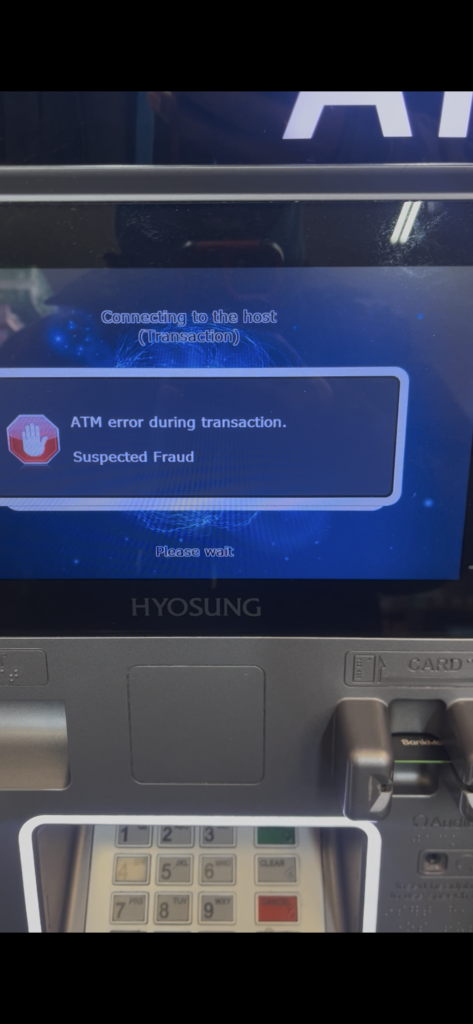
    Tried ATM declined too over “suspected fraud”🙄

    There’s money on the card though

    Previous similar incidents—Infragard nonsense

    So the deli folks just let me go and pay them the next day

    This is the kind of nonsense TIs are routinely subjected to by…you know who. So called “humiliation campaignssupposed to be SAD🙄

  • Department Of War Finally Addresses Directed Energy Weapons

    The Department of Defense, formerly Department of Defense has finally come out publicly and addressed the Directed Energy Weapons question. In a rather surprising tweet on 01/23/26, the Department declared: “Yes, the [Dept of War] has directed energy weapons.

    Prior to this declaration, defense department officials have been cagey about this particular topic, probably because a lot of this technology still remains classified.

    Targeted individuals have long pressured Congress to look into the use/abuse of such weapons to no avail—again probably due to classification issues.

    The dam however broke with the recent military incursion into Venezuela to arrest their president for a criminal prosecution in the United States. Reports from Venezuela indicated that the stunning raid carried out by the U.S. military involved some “magic weapons” which incapacitated and even killed Maduro’ s security. Some of the physical symptoms exhibited by Maduro’s security staff matched those previously discussed by victims of Havana Syndrome, leading to new media focus on the topic.

    As a result of the media pressure, the Trump administration quietly admitted the use of such exotic weapons in the Venezuela raid. They recently disclosed to the public that towards the end of the Biden administration, an undercover investigation into Havana Syndrome led to the purchase by the US government of a portable device the government believed, could cause Havana Syndrome symptoms, and that the government has been testing it for a year.

    That understandably shocked a lot of people because prior to that, the government had been very dismissive of such weapons, especially the fact portable versions of such weapons were already in circulation in the United States.

    Bottom line, it appears that after the directed energy weapons revelations in the Venezuela raid, the Trump administration has been trying to get ahead of the Havana Syndrome debate. The latest tweet by the Department of War is just the latest manifestation of that.

    Will the Trump administration finally address the elephant in the room regarding directed energy weapons—the lingering questions about targeting civilians—aka targeted individuals—in the United States who claim they have long been assaulted with such weapons?

    One hopes that the transparency the Trump administration has demonstrated thus far regarding this topic will eventually lead to the lingering question surrounding targeted individuals.

  • Is MSM Waking Up To The Dangers Of Neuroweapons?

    An interesting NY Post article recently explored what has become a growing issue of privacy, public safety, and national-security concern: the uneasy intersection between the remarkable benefits of neurotechnology and its potential for misuse. As the piece notes, advances in brain-computer interfaces, neuro-monitoring tools, and cognitive-enhancement research hold enormous promise for medicine and rehabilitation. Yet those same tools, if left unregulated or developed in secrecy, could be exploited by hostile actors in ways that raise troubling ethical and geopolitical questions.

    For years, mainstream discussion of neurotechnology focused almost exclusively on its medical potential, while any mention of misuse was often dismissed as fringe speculation. That posture has shifted as prominent neuroscientists and biosecurity experts—most notably Dr. James Giordano, a professor of neurology and bioethics and a long-time advisor to the U.S. military—have publicly outlined the real risks emerging at the intersection of neuroscience and national defense. Dr. Giordano has repeatedly warned that neurotechnology can be “weaponized” not only in the traditional military sense but also through subtler means: tools capable of influencing cognition, degrading decision-making, targeting vulnerable populations, or exploiting neurological data. He emphasizes that while these capabilities are still constrained by scientific limits, several countries are actively researching them, and the U.S. should take that fact seriously. His point is not that science-fiction mind-control devices exist, but that neuro-enabled tools—chemical, biological, digital, or data-driven—can be adapted in ways that create new forms of coercion, surveillance, or tactical disruption.

    The NY Post article raises the central policy question of whether Congress is exercising meaningful oversight in this domain. The concern is that many lawmakers are only dimly aware of how far neurotechnology has advanced, and even fewer grasp its defense implications well enough to legislate around it. Those with the deepest knowledge—typically members of intelligence committees—operate under heavy classification restrictions, which discourages open debate and leaves the public largely unaware of how these technologies may be used or misused.

    The article’s broader message is that it is time for Congress to engage this issue with urgency and transparency. Neurotechnology is advancing whether policymakers address it or not, and without clear guardrails, the same tools that promise extraordinary medical breakthroughs could also be adapted in ways that threaten civil liberties, public health, and global stability. The call, essentially, is for lawmakers to act before the risks outpace the regulations designed to contain them.

  • Post Housing Voucher Drama 111425 Edition

    A lot has happened since the last time I wrote about this topic. Importantly, HRA went and approved my CityFHEPS application and even sent me $$ for furniture

    Per the HRA app they’ve even made payments to the apartment folks, and my first rent contribution is due on 12/01/25. HRA is for real this time, folks.😳 Did the incoming Mayor Mamdani folks get in there and clean house? Hmm. All I know is they have been very “well behaved” since the election😂

    The HRA app shows that the money to the apartment was sent right around 11/08/25 so on my day off (Wednesday 11/12) I swung by the apartment to see if I could get the keys so I can, you know, start moving stuff into the apartment.

    The apartment managers told me they have NOT yet “received the checks”. Apparently the caseworker is supposed to bring the checks to the apartment folks. That part I didn’t know, but apparently it hasn’t been done—for whatever reason🙄

    Anyway, on the bright side, my electricity setup (public grid) was scheduled for today (Friday 11/14/25). So there’s a very good chance that when I stopped by the apartment on Wednesday, the power wasn’t on yet.🤷‍♀️Could that be the REAL reason they didn’t give me the keys—saving me from walking into darkness?😂 Hmm, could be. 🤔 

    And no, I didn’t act a fool with the apartment folks—I know that’s what you’re thinking.😂Its fait accompli in many ways, so there’s no need for that. I should be moving out any day now. You notice I’ve also toned down on the constant bitchin’ about HRA on Twitter. I mean it, they’ve been super good lately. 

    I’ll keep you posted on when I get the keys. Stay tuned.